10% OFF SALE PRICES WITH CODE EXTRA10 – ENDS MIDNIGHT SUNDAY
10% OFF SALE PRICES WITH CODE EXTRA10 – ENDS MIDNIGHT SUNDAY




 https://www.hopesgrovenurseries.co.uk/wp-content/uploads/2026/01/12-dec-24-ophiopogon-birch-snowdrop-cyclamen-john-massey-ashwood-photo-val-bourne-750x500.jpg
Most of you will have noticed that we’re getting heavier bursts of rainfall in this country, so much so that some areas have had over double the amount of average rainfall this year. In 2022 -2023 we had an extremely wet, mostly warm winter and 2024-2025 seems to be following the same pattern. We have already had a cool, wet summer in The Cotswolds, where I live, and that’s been followed by a warm, wet autumn. This may continue to be the pattern as we head through to spring 2025. We’ve also suffered twelve storms in recent months, according the Met Office, and they’ve all delivered hours of heavy rain over my garden.
Deciduous trees and shrubs have responded to the wetter and milder conditions by putting on huge growth spurts. The extra moisture has also super-sized the leaves and leaf fall has been affected as well. These days the leaves are dropping roughly three or four weeks later than they used to. By the time the last leaf has finally fallen plants like hellebores are already showing buds. Raking them up is impossible, so it’s a slow hand-gathering job to prise them away from the wet ground. I’m sure you can sense my pain.
The wetter conditions mean that woody plants are more vital than ever though. They not only add perspective and structure above lower growing plants, their roots also drain the soil and their overhead branches, whether leafy or bare, offer protection and dissipate the effects of cold weather, strong winds, heavy rain and hot sunshine, conditions made worse by climate change.
Bulbs suffer really badly in wet winters and miniature bulbs, such as daffodils, snowdrops, crocuses and choicer muscari, can rot off and disappear in these conditions. However, they thrive close to trees and shrubs due to the extra drainage provided by woody roots sucking up the moisture. I grow an early flowering miniature daffodil, Narcissus ‘Cedric Morris’, but my only surviving patch is under a smoke bush named Cotinus coggygria ‘Royal Purple’. I’m growing my smoke bush in the autumn border and it’s a very useful thing because it doesn’t leaf until late spring, so the bulbs have time to replenish their store of food. It also hangs on to its leaves late, so the deep-red foliage offers late colour among fading beige and brown grasses,
Smoke bushes have fluffy pink flowers that float above the rounded lollipop-shaped foliage and these inflorescences fade into fluffy filigree heads as autumn approaches. These fragile heads pick up the beige fluffy heads of tall grasses, such as Miscanthus sinensis, and that unites the planting scheme. There are yellow-leafed forms and red-leafed forms of smoke bushes on offer.
My surviving clump of Narcissus ‘Cedric Morris’, which often flowers by Christmas, is close to several choice hepaticas chosen for their excellent foliage. These woodlanders also rely on extra drainage, courtesy of my smoke bush. They include ‘Stained Glass’ and ‘Ashwood Marbles’. Hepaticas can be tricky in the garden because they need to get the sun in winter and spring, but after that they need cool shade throughout summer. They share this trait with winter aconites. Plant both under shrubs or trees – but not on the sunny south-facing side. They both hate being baked.
A slightly later miniature narcissus, ‘Bowles’s Early Sulphur’, also thrives under my smoke bush and that’s another small bulb I’ve lost in other places – due to wet conditions. Snowdrops do well under rose bushes and many of my snowdrops are planted in the lea of my pruned roses. The snowdrops flower before the rose foliage reappears and there’s plenty of time for the snowdrops to die down and replenish themselves before the roses get going.
Woodlanders must have leafy cover in summer too, because these opportunistic plants flower before the leafy canopy closes overhead. Fortunately, many early-flowering shrubs have fragrant flowers designed to lure in early pollinators. Winter honeysuckle, Lonicera fragrantissima, has cream-white flowers that can appear in December in milder years. The sweetly scented flowers are often visited by honey bees on warm winter afternoons. It’s a large shrub, forming a 7 to 8 feet roundel (2m x 2m) and it’s not the tidiest in summer, admittedly. However, it’s terrific close to a gate or pathway because the fragrance welcomes you when you return home. It picks well for the vase too.
Prune it back after flowering if needed and that’s a rule of thumb for most flowering shrubs, after all you don’t want to cut off the flower buds. My winter honeysuckle encourages snowdrops, polpody ferns, hellebores and pulmonarias and I have clumps of Galanthus woronowii and Galanthus ikariae under the branches. These green-leafed snowdrops do better here than anywhere else in my garden. It’s the only spot where the green-tipped ‘Cider with Rosie’ survives – tucked up in the roots! It’s very happy there, although I’ll never be able to divide it!
You could also use the taller Viburnum x bodnantense, although this upright shrub is best on a garden boundary due to its height. It will reach ten feet (3m). You’ll still be able to pick up the heady hyacinth-like scent on the air if it’s on the garden edge, because it travels so well. The fragrance is at its strongest in November – a month that needs all the help it can get.
Cherry blossom works well with woodlanders too and it generally waits for March. One of the best shrubby plants of all, and in my Top Ten Shrubs, is Prunus incisa ‘Kojo-no-mai’. This divaricate, shorter Fuji cherry, more shrub than tree, has small confetti-like flowers in pink and white all along the branches. It’s a great foil for rich-blue miniature bulbs like Scilla siberica and the non-invasive Muscari aucheri ‘Blue Magic’. Don’t, for goodness sake, plant the rampant self-seeder S.bifolia among your choice woodlanders! You’ll have it forever. Use this for wilder areas instead, where it won’t matter.
Small trees are equally good at draining and shading the ground and Acer griseum, the Paperbark maple, is slow-growing so it makes a good shape. This tree develops cinnamon-brown bark that peels away and, when the winter sun shines, it highlights up every ripple and curve. Give it a bright position, so that the sun highlights the translucent edges, but it will need shelter as well. The paperbark maple, one of the most effective small trees ever, it will also provide red autumn foliage and spinning helicopter seeds. This is a tree for every season and my favourite thing is when the buds break to reveal zingy lime-green leaves.
Birches can be used in exactly the same way and Betula papyrifera is known as the paper birch because the bark also peels away, revealing the silvered trunk below unfurling golden-edges. The linear lenticels, the bumpy raised bits on the trunk, are also golden-brown and these show up really well in low light. And you also get golden autumn foliage. Wash your birch trunks in August for extra winter sparkle.
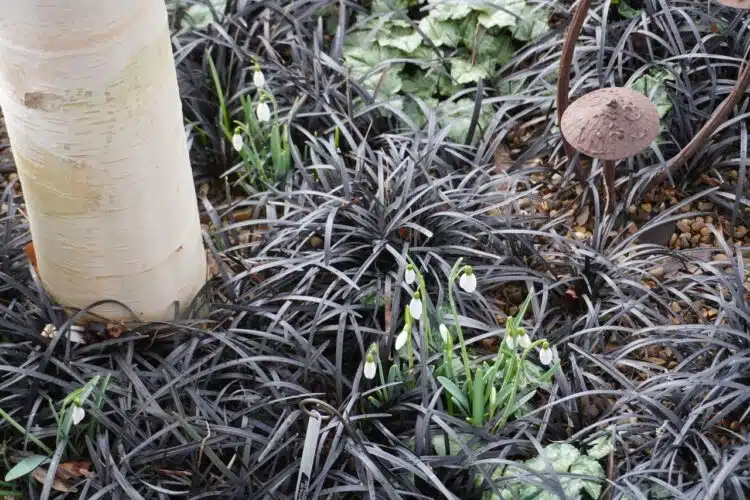
Birches are shallow rooted trees so they drain the ground very efficiently. Permanent plantings are best under birches, because it’s easy to disturb the roots. Suitable candidates include autumn-flowering Cyclamen hederifolium, grown for its late summer flowers and silver-marked winter foliage. The black strappy grass-like plant, Ophiopogon planiscapus ‘Nigrescens’, also sits well with the pale trunks of Himalayan birches. ‘Jacquemontii’. The starker white bark will flatter snowdrops, planted amidst the black ophiopogon and cyclamen foliage. The twiggy overhead canopy of birches is almost-black, so this is a monochrome sophisticated tree in town or country – but do give it a prominent position so that it shins.
Birches and many maples provide a light twiggy canopy, so you get magic lantern patterns on the ground as the sun moves round. And your plants will be so much happier tucked underneath them because the roots will be sucking up the rainfall. Once the foliage arrives it will act as sunshade too – for who knows what the weather will do next!

Looking to spruce up your garden this year and need some new ideas? Discover our predictions for the top 2026 gardening trends in the UK below – set to focus on sustainability, smarter use of space, and creating gardens that support both people and wildlife. Top 5 Biggest Gardening Trends For 2026 1. Native planting:…
I’m a lifelong organic gardener and, I always say, it’s for all the wrong reasons. I grew up in the early, cash-strapped 1950s, when gardens were not exposed to a barrage of chemicals. There weren’t many products to buy, but most couldn’t afford them anyway because the household budget was strained. My organic mentor was…
As we creep towards the shortest day a certain sort of magic descends. Low light slants through the garden and picks up all the detail of line, texture and silhouette. I noticed this many years ago when I gardened in Hook Norton on Oxfordshire. All the older gardens had the same sturdy giraffe-like cooking apple…