20% OFF SALE PRICES WITH CODE EXTRA20 – ENDS TONIGHT
20% OFF SALE PRICES WITH CODE EXTRA20 – ENDS TONIGHT




 https://www.hopesgrovenurseries.co.uk/wp-content/uploads/2022/09/atropurpurea-al-Copy-750x688.jpg
The words ground cover don’t set the world alight, admittedly However, plants that spread and cover the ground are highly useful in the garden setting. They unite your planting scheme, for one thing, often in difficult areas such as dry shade or dry soil. And the fact that they are covering the soil excludes the light and discourages weeds from germinating. That saves time, the most valuable gift of all, leaving you free to do something else.
Ground cover plants are even more important these days, because we are living in changing times. Our world is becoming noticeably warmer and wetter. Low-level foliage helps to diffuse the effects of heavy rainfall and allows water to percolate downwards at a slower rate and this helps to alleviate flooding. The green rewards go further than that though: for areas covered in plants lock carbon and nutrients into the soil because you’re not disturbing the ground and exposing it to sunlight. If the ground isn’t disturbed, you’ll get fewer weed seedlings so it’s a win, win situation for the busy gardener. I’m reminded of some salient advice given to me about weeds when very young. Never disturb the soil in spring! I’ve stuck to it for decades – where ever possible.
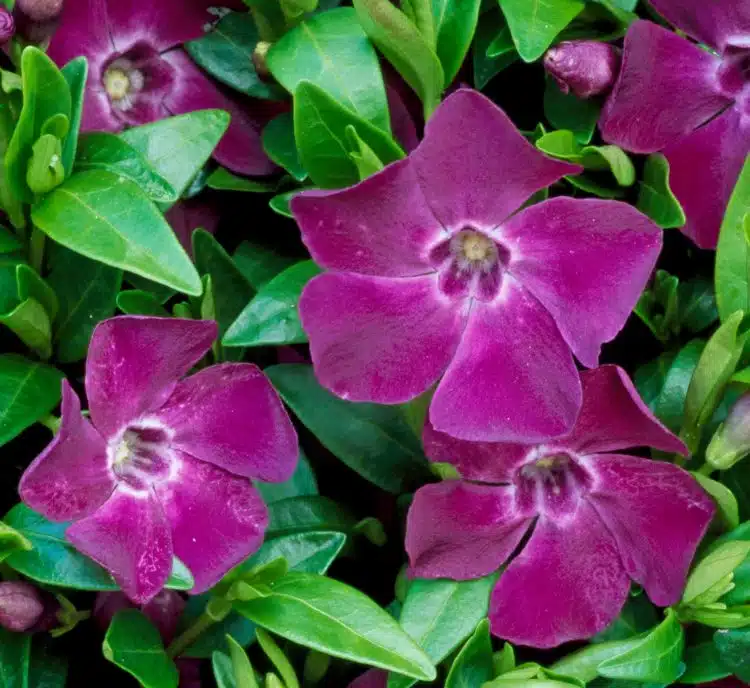
Ground cover plants need to be placed carefully, otherwise they will smother less-vigorous treasures as they spread. Take periwinkle, or Vinca, a spring-flowering plant that spreads by producing runners rather as strawberries do. There are two species V. minor and V. major and their species’ names relate to height. V. minor is shorter and the leaves and flowers are smaller too. Its maximum height is between 6 – 9 inches, or up to 23cm. The short runners create a matrix of stems, so there are no gaps to be seen once it’s established. It is difficult to eradicate once planted though, due to the complex network of stems. Don’t let that put you off, for it’s a great weed-excluding plant and it’s not fussy about soil or conditions.
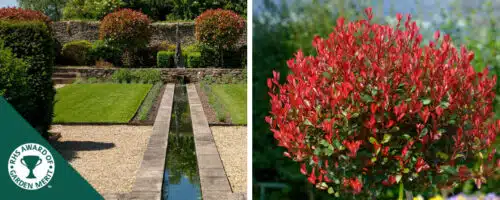
Venerable gardeners like Edward Augustus Bowles (1865- 1954) of Myddelton House near Enfield have their own forms named after them. ‘Bowles’s Variety’ has shiny green foliage and azure-blue flowers with a paler star-shaped mark right in the middle. It’s an AGM plant, or Award of Garden Merit, and it makes a great edger in a semi-shaded spot. Bowles was an Edwardian gentleman and, unable to take holy orders due to the early demise of his brother and sister from tuberculosis, he spent a lifetime serving his community instead. He ran a Boy’s Club in order to educate the less-privileged lads of the borough. They became known as Bowles’s boys and they attended evening classes in the town because most had left school at 14.
Bowles, a man with a great eye for a plant, loved the month of May and Vinca minor is particularly good then. In My Garden in Spring, first published in 1914, he writes “if a fairy godmother or a talking fish offered me three wishes I think one would be to have the clock stopped for six months on a fine morning towards the end of May. Then, perhaps, I might have time to enjoy the supreme moment of the garden.”
It seems fitting then that Bowles’s personal time clock ran out on May 7th 1954. He was being tended by Charlie White, one of his Bowles’s Enfield boys and one of his long-serving gardeners. I managed to speak to Charlie, just before he passed away, and it was a real privilege to hear about his time with the great man who did so much for others. Bowles remained unmarried and stayed in the family home with his parents, often the plight of the youngest sibling. He had quite a lonely old age, having out-lived many of his contemporaries. Myddelton House is open and maintained by the local council. It’s free to enter, but you will need to pay to park. Google it or Visit Lee Valley.
The equally venerated Gertrude Jekyll (1843-1932), of Munstead Wood near Godalming, also has a pure-white lesser periwinkle named ‘Gertrude Jekyll’. This most-painterly of gardeners was famous for limiting herself to using only three or four plants in large swathes within her borders. She did have eleven acres to play with though and, at least three of them, were devoted to shade. Her famous sentiment that “the love of gardening is a seed once sown that never dies” is one I fully condone.
White can be a tricky colour in the garden unless it’s supported by lots of green foliage as in The White Garden at the National Trust’s Sissinghurst. However, this lesser periwinkle is a charmer due to the lovely green foliage framing the gappy-petalled white flowers. There’s a tastefully variegated lesser periwinkle too, ‘Argenteovariegata’, with soft-blue flowers and cream-edged sage-green foliage
The taller periwinkle, V. major, sends out long runners that land at least a foot away, like some vast looper caterpillar. It will land in the middle of a hellebore, like some alien space invader. It provides looser groundcover, but the flowers are earlier and larger, and it’s good at thriving on the shadier side of walls or fences, where little else grows, or at the back of woodland borders.
Gertrude Jekyll was famously fond of bergenias as well. These large-leafed plants, known commonly as elephant’s ears, have sumptuous foliage that reddens in winter. In Wood and Garden, she declares: ‘I am never tired of admiring the fine solid foliage… remaining, as it does, in beauty both winter and summer, and taking on a splendid winter colouring of warm red bronze.’ The cerise-pink flowers of B. cordifolia ‘Purpurea’, which appear in spring, are held on long stems above large oval leaves. As winter descends the reddish-hued leaves add much to the winter 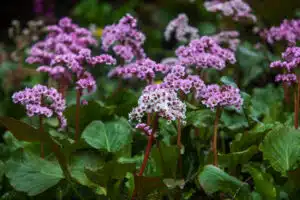 garden. I find bergenias need a sheltered site and good soil in order to thrive. However, once happy these majestic plants provide metre-wide roundels of foliage. They’re often used under the outer lee of large trees and paths and they are also good at lolling over low stone walls.
The foliage of Pachysandra terminalis, the Japanese spurge, is under appreciated. This hardy, low-maintenance evergreen is deer-resistant and it forms a green carpet on the flat, or on a slope. There are rather insignificant white flower spikes in late spring, but this is foliage plant grown for principally for its beautifully arranged rosettes of toothed foliage. It’s capable of performing in darker areas of the garden, as long as it isn’t too dry. In hard winters it can lose some foliage, but the leaves soon return.
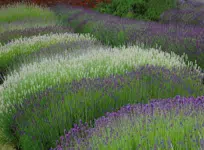
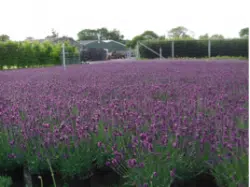
Brighter areas of the garden, that tend to dry out, also benefit from sun-loving ground cover and aromatic grey-leafed nepetas are excellent. The knee-high ‘Six Hills Giant’ provides a soft-blue haze and it begins the flower in May. By July it can look tired, but if you shear it back to nothing it bounces back straight away and makes September glorious. These greyer-leafed catmints need well-drained soil. If the ground’s consistently damp throughout the year, the foliage will turn sage-green and flop horribly. They are perfect mingling close to pink and cream roses that might include the soft pink repeat-flowering ramble ‘New Dawn’, or the healthy floribunda ‘Champagne Moment’.
The far shorter Nepeta faassenii is a compact foot-high catmint with blue flowers mottled and speckled in white at the throat. This is perfect for a low billowing edge, or it can be mass-planted so that the plants run together. Nepetas please the bees, because they produce lots of concentrated nectar over many months. They also soften planting schemes.
Deep-blue is colour in short supply and one of the best autumnal flowering plants is the lower growing Chinese plant Ceratostigma plumbaginoides. Known as hardy plumbago, due to its five-petalled blue flowers, this plant loves a sunny sheltered edge. It’s spectacular in September light, when the foliage and buds develop a reddish colour. This intensifies as temperatures cool. It’s a lovely edging a path and the gentian-blue flowers are beloved by gardeners and butterflies. Or you can create drifts.

Looking to spruce up your garden this year and need some new ideas? Discover our predictions for the top 2026 gardening trends in the UK below – set to focus on sustainability, smarter use of space, and creating gardens that support both people and wildlife. Top 5 Biggest Gardening Trends For 2026 1. Native planting:…
I’m a lifelong organic gardener and, I always say, it’s for all the wrong reasons. I grew up in the early, cash-strapped 1950s, when gardens were not exposed to a barrage of chemicals. There weren’t many products to buy, but most couldn’t afford them anyway because the household budget was strained. My organic mentor was…
As we creep towards the shortest day a certain sort of magic descends. Low light slants through the garden and picks up all the detail of line, texture and silhouette. I noticed this many years ago when I gardened in Hook Norton on Oxfordshire. All the older gardens had the same sturdy giraffe-like cooking apple…