10% OFF SALE PRICES WITH CODE 10MORE – ENDS TONIGHT
10% OFF SALE PRICES WITH CODE 10MORE – ENDS TONIGHT




 https://www.hopesgrovenurseries.co.uk/wp-content/uploads/2026/01/Alamy-jan-25-K14HN1.jpg
Most gardeners want to help wildlife, because it’s not what it was, and many of you feed the birds with sunflowers seeds and peanuts in winter in order to help out. Watching the bird feeders is an entertainment in itself and the extra food has allowed members of the tit family and finches to thrive during hard winters. However, once these birds begin to nest and breed in spring, most of them have to find small wriggly things to feed their young, because peanuts and seeds don’t do the job for baby birds. They need wriggly little creatures full of protein.
Take the average brood of 8 -10 blue tits. Their parents will need to find roughly ten thousand insects and grubs over a period of three weeks. There are aren’t enough insects and minibeasts about these days, so more and more birds are failing to thrive. Please lay off the pesticides, because you have your own personal army of garden helpers out there, including your blue tits. They will happily collect aphids from your roses and caterpillars from your apple trees in spring and early summer.
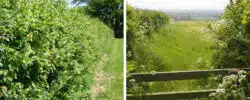
Nesting sites are also a problem these days because there aren’t enough of them. We have four bird boxes and one of them, not necessarily the same one, is usually occupied by great tits or blue tits. They are a delight to watch as they go back and forth to their young, food in their beaks. However, bird boxes are vulnerable and great spotted woodpeckers can (and do) come a long and devour the young. The baby birds are often safer in a hedge and this is the best time of year to plant a nature friendly hedge. This will help to increase the number of insects in your garden, because native plants have a long association with our fauna, a posh word for wildlife.
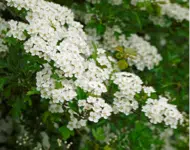
The hawthorn for instance, that May Queen of hedging, is decorated with cake-scented domes of white flowers that satisfy lots of pollinators. It could attract 149 species of insect in Britain and those insects would be perfect for your baby bird buffet. In fact, hawthorn is the fourth most attractive plant to insects. The top three are oak (284), willow (266) and birch (229) so, if you want a garden buzzing with life, go native. A hedge of native plants will also provide much-needed nesting sites.
It isn’t expensive because native hedges go well from inexpensive bare-root whips and these will form a hedge within a few years. You’ll be providing flower for a whole range of pollinators, fruit for your robins, blackbirds and thrushes, and plenty of crevices for insects to hide away in.
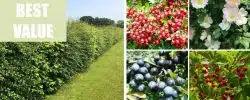
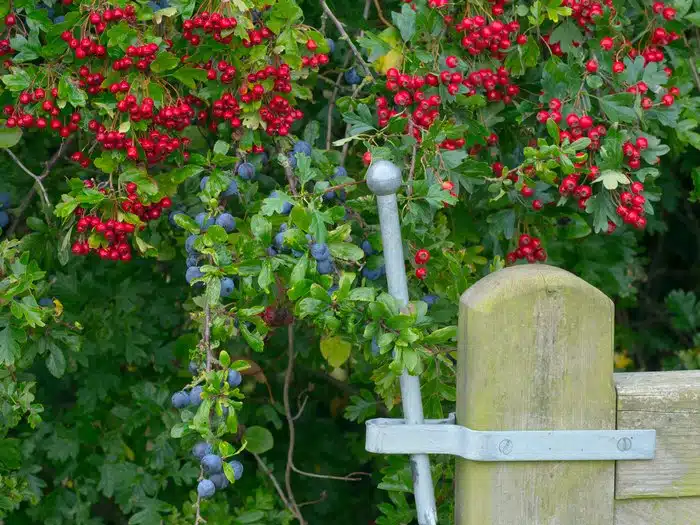
Hopes Grove’s Bird-friendly Mix, which can be planted straight into the ground between November and the beginning of April, contains a third of hawthorn or quickthorn, or Crataegus monogyna whips. This is the plant your see studded with red haws in early autumn and, if you look closely, you will see that these haws are rather like miniature rose hips. Not surprising really, because hawthorn is a member of the rose family, or Rosaceae. It’s the hedge most farmers turn to, because it produces a thick, twiggy windbreak quickly. It’s easily grown in a variety of soils and it’s very hardy.
Hawthorns create the unifying theme hedging plant as you cast your eye along. The old adage, never cast a clout until spring’s out, refers to the blossom and country dwellers always know, that once the blossom’s out, summer is here. This plant’s clever too, because it can satisfy a whole range of pollinators from small-mouthed hoverflies up to long-tongued bees, and the flowers have excellent timing. They follow on from the spring-flowering plants, but pre-empt the summer-flowering meadow plants. The hawthorn flowers are hermaphrodite and have female and male parts within the same flower. If there aren’t any pollinators about, they can produce fruits, although they will produce far more if pollinated. Winter visitors, like fieldfares and redwings, rely on them.
Country folklore is rather suspicious of May blossom, because they were associated with the pagan celebration of May Day. It is thought unlucky to bring the blossom into the house, possibly because the thorny foliage has been associated with Jesus’s crown of thorns. In Ireland hawthorn is associated with fairies, according to Roy Vickery’s excellent book Vickery’s Folk Flora. Others report that the flowers smell of the Great Plague of London in 1665. In those days bodies were kept at home for several days before the funeral, a practice that lasted for many centuries, so perhaps there is some truth in this assertion.
The sloe bush, Prunus spinosa, makes up another third of this mixture and these black fruits are really attractive to birds and to people who make sloe gin to drink at Christmas. The white flowers are prompted into flower by cool temperatures and country folk often mention the blackthorn winter, because the weather rarely warms up when this is out. Once it browns, warmer weather is close by.
The Woodland Trust tell us that the sloe is a valuable plant for wildlife beyond the pollen end nectar of the flowers. The foliage is a food plant for the caterpillars of many moths, including the lackey, magpie, swallow-tailed and yellow-tailed moths. It is also used by the black and brown hairstreak butterflies. The small white eggs, rather like miniature sea urchins, overwinter in the nooks and crannies and I have hunted them down on New Year’s Day. Birds love to nest among the dense, thorny thickets as well and the linear foliage makes a good contrast to the smaller, rounder hawthorn foliage.
Hornbeam forms another third of this mixture. The Latin name, Carpinus betulus, refers to the similarity of the foliage of beech, or Betula. Hornbeam leaves are thicker in texture and they have highly serrated margins on the leaves – reminding me of those corrugated thick potato crisps that I shouldn’t be eating! It is slower growing, but it tolerates windy and exposed sites, so it’s often grown as a pleached hedge on garden edges. In recent years, this has become a designer go-to.
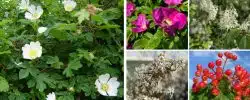
The remaining 25% of this bird-friendly mixture contains a selection of alder, hazel, dog rose, dogwood, bird cherry or spindle. Hazel, Corylus avellana, will provide yellow catkins, often known as lamb’s tails and, although hazel is wind pollinated, queen bumblebees collect the pollen because they need it for their brood. It’s powdery, so they can’t carry very much of a time. The ideal pollen for pollinators is stickier. The yellow catkins are male flowers, but look carefully and you can see the tiny red female flowers a little way away. They resemble miniature red sea anemones. The leaves are softly textured and pale-green and they open in April, adding softness to a spring day.
The stems are pliable and it’s possible to cut sticks for peas, or long poles for bean tripods, or for domed structures for staking. I have a small hazel coppice on my allotment, that I raid for various purposes. Thatchers used the twigs and branches to fix the straw and reed bundles to the roof, because they needed bendable, pliable wood.
Hazel leaves make dry leaf litter and plants and bulbs love to push though the brown leaves in spring. Ground nesting birds also love to nest in hazel and willow warblers will use them in gardens. The nuts attract squirrels, not the most welcome garden visitor, and they eat the nuts before they ripen. The nuts are also eaten by mice and this includes the rare and protected hazel dormouse. These dormice will also eat any moth caterpillars they find, before going into hibernation.
Hazel also has a magical reputation and a hazel rod by the house was said to ward off evil spirits. The wands could be used for water divining as well, but they had to be forked or y-shaped. Hazelnuts were carried as charms and they were said to prevent rheumatism. In Ireland, the hazel was known as the ‘Tree of Knowledge’, and in medieval times it was a symbol of fertility.
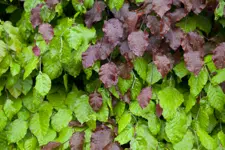
Common dogwood, Cornus sanguinea, looks best as the temperatures fall because the leaves turn purple-red before dropping to reveal the greenish-red stems. Like many dogwoods with colourful stems, it will tolerate damper soil. The wood is so hard that it was used for crucifixes, according to The Woodland Trust. The name dogwood is a corruption of the Westcountry word dawk. The name was confused by William Turner (1508-1568) with dog, a term used to denote a poor performer.
Once the leaves fall the grey, upright framework can be appreciated and there may be clusters of black berries. sometimes called dog berries. The flowers are said have an unpleasant smell and that’s probably an indicator that this plant is pollinated by flies. They love an unpleasant odour,
There are several choices of native hedge on the Hopes Grove website, including a paddock mix, a flowering mix and an edible mix and they’ll all benefit wildlife hugely. Happy planting!

I’m a lifelong organic gardener and, I always say, it’s for all the wrong reasons. I grew up in the early, cash-strapped 1950s, when gardens were not exposed to a barrage of chemicals. There weren’t many products to buy, but most couldn’t afford them anyway because the household budget was strained. My organic mentor was…
As we creep towards the shortest day a certain sort of magic descends. Low light slants through the garden and picks up all the detail of line, texture and silhouette. I noticed this many years ago when I gardened in Hook Norton on Oxfordshire. All the older gardens had the same sturdy giraffe-like cooking apple…

We are one of just a handful of online nurseries to have attained Plant Healthy certification. In a nutshell, it’s a way of proving that we will always do the right thing in preventing the spread of harmful plant pests and diseases. The Plant Healthy Management Standard is a voluntary initiative that sets out requirements…