10% OFF SALE PRICES WITH CODE EXTRA10 – ENDS MIDNIGHT SUNDAY
10% OFF SALE PRICES WITH CODE EXTRA10 – ENDS MIDNIGHT SUNDAY




 https://www.hopesgrovenurseries.co.uk/wp-content/uploads/2022/09/chasmanthium-latifolium-shutterstock_1158446548-1.jpg
September is one of those sea-change months in the gardening year. The days are getting shorter and the nights are getting cooler because the sun’s dipping towards the horizon, little by little every day, right up until the Winter Solstice when brighter times will beckon. Expect autumn mist to swirl through your garden at break of day but, just like dragon’s breath, it will soon melt away. And as the sun heads skyward it will slant through your border, picking up intricate details whether it be a shiny mahogany-red rose hip, or a translucent seedhead, or a shimmying and shaking grassy awn.
I couldn’t do without those fluffy awns and September’s the best time of year to appreciate taller late shoulder-high grasses because they add texture, movement and drama when backlit by afternoon and evening sun. The King of the Grasses is definitely Miscanthus sinensis and it’s been used in gardens for over a hundred years. The painterly Gertrude Jekyll (1843-1932) favoured the arching green leaves of ‘Zebrinus’ because the yellow horizontal bars cast their own light and shade. Her contemporary William Robinson, writing in The English Flower Garden published in 1883, admired the way their branches curve over gracefully and likened the heads to a Prince of Wales feather. They both knew micanthus as Eulalia japonica, which sounds like a form of praise in itself. Halleluja for Eulalia, I hear the garden ghosts cry!
Robinson and Jekyll would have marvelled at the range of on offer today and we must thank the German nurseryman Ernst Pagels (1913-2007) for all this abundance. Having noticed that Miscanthus sinensis rarely set seed in the cool climate of northern Europe, Pagels used a heated greenhouse to extend the growing season of ‘Gracillimus’ thereby producing a seed crop. Obligingly, the first batch of seedlings showed great variation, and subsequent generations produced some stunning cultivars displaying richly coloured flower plumes ranging from plum-red through to mink-brown and silver. Heights also vary.
‘Ferner Osten’, which translates as Far East, is almost certainly Pagels best red selection and it produces wine-red silky heads early in the miscanthus season. If you’re in the banana belt of southern England you’ll get plumes in the second half of summer. Those in cooler districts (like me) may have to wait until August or the autumn. The shorter ‘Red Chief’ combines maroon-red plumes with colourful foliage in gold and green with reddish highlights. All these red-plumed miscanthus fade to shades of silver and beige within four to six weeks. They’re clump-forming and non-invasive and the best way to establish a clump quickly is to plant three about two-feet apart (60cm).
Miscanthus sinensis has good foliage too and this usually fountains out so most form generous, graceful mounds and they mix well with tall and late herbaceous that may include Sanguisorba officinalis ‘Cangshan Cranberry’ or Veberna bonariensis. Allow them to fade through winter and then you’ll be able to admire their silhouettes. I prefer to cut my miscanthus back in early spring, because they re-shoot early.
Karl Foerster, another German nurseryman and landscape architect, referred to grasses as nature’s hair and he pioneered their use in amenity planting and in gardens. Calamasgrostis x acutiflora ‘Karl Foerster’, known as feather reed grass, has slender metre-high clumps that can be woven through a border to provide an architectural backbone. The purplish awns emerge in summer and they are vulnerable to strong wind and heavy rain at this stage so windy, exposed sites can be problematic. By late summer the narrow heads and stems have turned brown to form a golden sheath. Plant several to get the full effect, either as a snaking ribbon or a block. Cut them back in early spring.
Karl Foerster also gave his name to a tall purple moor grass, Molinia caerulea subsp. arundinacea ‘Karl Feoerster’. This turns golden-brown in September. ‘Transparent’ is an airier form with tiny beads that can darken to almost-black in colour. In certain lights it will sparkle like jet. It creates a veil by mid-summer when long stems rise above the grass-green foliage and it makes a good plant to peer through. The flowering stems tend to collapse by midwinter, so cut it back in December. Even then, seedlings often follow and may not come true. The young fresh foliage is an excellent backdrop for tulips. The name arundinacea, meaning arundo-like, is important because these named selections are the tall ones. It’s missing in shorter varieties.
Some winter season sedges shine at ground level, particularly those with fibre-optic narrow tines. They corkscrew out from a tight waist and create spirals of movement. It’s possible to grow early-spring bulbs, such as Anemone blanda, close to them. Among the best is the warmly tinted Carex testacea ‘Prairie Fire’, a gingery-red New Zealander suited to pots and open ground. If a plant’s colourful in winter, make sure that winter sunshine can enhance it. Give any winter star an open position. The bleached tines of Stipa tenuissima can also look fabulous in winter.
There are steely grasses for winter effect too and switch grass, or Panicum virgatum, is a warm-season American prairie grass that usually produces pink panicles of flower above steely grey foliage. The metallic foliage inspired the late Kurt Bluemel to name one selection ‘Heavy Metal’. Bluemel’s ‘Warrior’ has greener foliage and pinker awns. ‘Squaw’ is a shorter version of ‘Warrior’. Panicums need good soil and summer heat to flower and flourish, however. They dislike dry conditions and cool gardens. Give it a warm spot and be prepared to water too.
Deschampsia cespitosa is more accommodating about temperature, although this widely-spread grass still needs moisture. Given that it will form a knee-high mound of fine foliage and flower, almost cloud-like in appearance. In autumn the whole plant turns to harvest gold.
Not all grasses wait until later in the year, thankfully, and Stipa gigantea will send out stems of golden flower, held above silvery fine foliage, just as the alliums flower. This man-high grass continues to shine throughout summer and early autumn and it prefers cooler conditions – so it succeeds in the UK. Stipas need space to shine and this is important because stipas hate being divided or moved. Once planted, it pays to leave them to their own devices otherwise you’ll lose them. They can be trimmed round the sides in autumn, almost like a large cake. Leave the middle and top intact.
Lower growing summer grasses include foxtail barley, Hordeum jubatum which is excellent in a sunny position. The silver-white heads emerge in summer, crooking their necks, and then turn to shades of burnt caramel and pink candyfloss. One foxtail barley will get lost, plant several and you can save the seeds – because this one is short-lived. Don’t let that put you off: it will self-seed in warmer sunny places, particularly so in gravel. Briza media is one of our native meadow grasses and this one will definitely self-seed. Early summer sees the dainty dark spikelets emerge and tremble, earning it the common name of quaking grass. Once the spikelets soak up the sun and turn to hay-field brown. A great dried flower and a useful filler with sun-loving annuals too. The seeds germinate in autumn winter quite often and the twisted foliage adds winter interest.
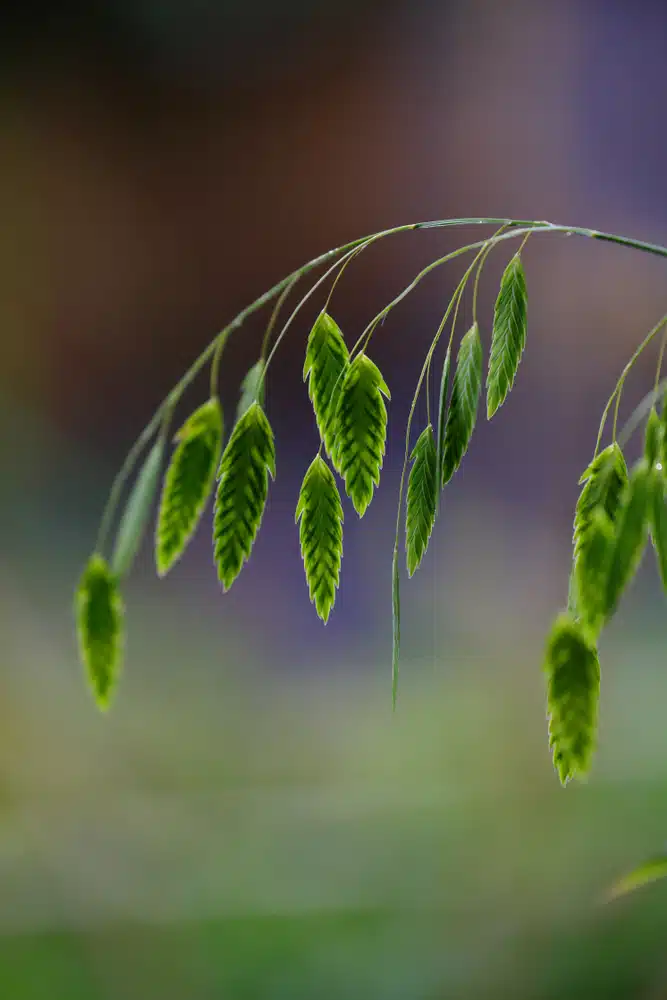
Those with clay-soil or moist soil may do well with the Chasmanthium latifolium, an American grass that will also tolerate drier conditions. Green, flattened, elliptical heads appear in summer and colour up to shades of pale-pink and then light-brown. They hang their heads rather coyly, to great effect, and this is a grass that should be grown more often.
My all-time favourites are pennisetums, because they offer such diversity of shape and form, from oval head, to thick hairy bear caterpillar. Pennisetum alopecuroides ‘Hameln’ is the hardiest form and it’s willing to flower well in cooler gardens, producing bottlebrushes on splayed stems by late summer. ‘Little Bunny’, also free-flowering, is a miniature version of ‘Hameln’ and it will rise to eighteen inches, or 45cm. You need to appreciate the shape of these and they have gossamer edges in sunshine. They also trap the raindrops and mist and this makes them look like garden jewels. If you buy a showy one, treat it like an agapanthus and keep it in a pot over winter. They seem to come easily from seeds  sown in spring.

Looking to spruce up your garden this year and need some new ideas? Discover our predictions for the top 2026 gardening trends in the UK below – set to focus on sustainability, smarter use of space, and creating gardens that support both people and wildlife. Top 5 Biggest Gardening Trends For 2026 1. Native planting:…
I’m a lifelong organic gardener and, I always say, it’s for all the wrong reasons. I grew up in the early, cash-strapped 1950s, when gardens were not exposed to a barrage of chemicals. There weren’t many products to buy, but most couldn’t afford them anyway because the household budget was strained. My organic mentor was…
As we creep towards the shortest day a certain sort of magic descends. Low light slants through the garden and picks up all the detail of line, texture and silhouette. I noticed this many years ago when I gardened in Hook Norton on Oxfordshire. All the older gardens had the same sturdy giraffe-like cooking apple…