***20% OFF SALE PRICES WITH CODE MARCH2026 – ENDS TONIGHT!***
***20% OFF SALE PRICES WITH CODE MARCH2026 – ENDS TONIGHT!***




 https://www.hopesgrovenurseries.co.uk/wp-content/uploads/2026/01/silver-birch-shutterstock_2213087499-750x475.jpg
As we creep towards the shortest day a certain sort of magic descends. Low light slants through the garden and picks up all the detail of line, texture and silhouette. I noticed this many years ago when I gardened in Hook Norton on Oxfordshire. All the older gardens had the same sturdy giraffe-like cooking apple tree, although we never knew what it was! As winter arrived the trunk would develop camouflage patterns in grey, khaki and brown and you could see the lichens and ragged pieces of bark in clear focus. I often watched from the window, on the sort of day that didn’t encourage you to garden. The strange thing was, the same sturdy apple tree took on a different persona in summer. Under the high sun, it looked as grey as an elephant’s leg.
It was the same trunk, seen under different light conditions and it reminded of the moment when I explained to my two young children that the stars didn’t come out at night. It was just that you couldn’t see them once the sun was up. They were there all the time, I told them, but only shone in the dark. My announcement was met with a blank stare of incredulity, a look they went on to perfect during their teenage years. What is she on about now!
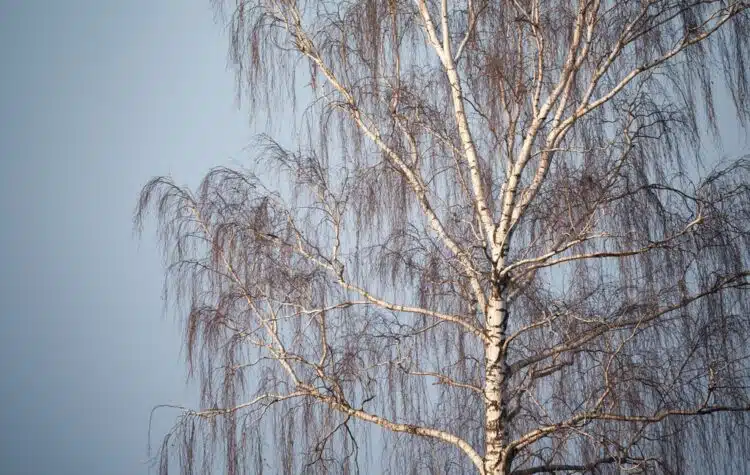
The low light makes winter the season to admire trees and the king of winter showmen is the Birch in all its forms. The canopy, made from dark twiggy branches, is transparent and airy and allows patches of light to illuminate the ground below Those patches move with the sun, throughout the day, creating a magic lantern pattern on the ground. The twiggy overhead branches protect plants on the ground and the roots drain and warm the ground. As a result, early flowering plants are happier under the benign presence of a light woody canopy. They’re like mother hens.
The trunk’s usually the best bit though and I’ve always been a bit of a tree hugger and I started young. The peeling bark attracted me and, and aged about seven, I retrieved a piece of bark from the ground and admired the morse-code pattern made by the darker lenticels. I felt the silky texture between my fingers. Birch bark is in a constant state of renewal and peeling bark catches the sunlight so the edges take on translucent character, like a host of haloes.
Once I’d examined that piece of bark and tucked it away in my bag, I leant against the trunk and it exuded the sort of warmth you get from your cat when it curls up close. I leant against that tree in my local park many a time, on bleak midwinter days and just bleak days, and I felt comforted. Trees are like hibernating animals waiting for spring bud burst. When the birch buds break the leaves often resemble corrugated green diamonds and they flutter round the stubby yellow catkins.
Himalayan birches develop a silver-white patina that enhances the dark branches above. It’s a very art deco and elegant combination and, like all trees, it deserves a place in the spotlight. Too many trees get tucked away on boundaries, where the sun never reaches them, and I’ve committed this crime in my old, much-loved garden in Hook Norton. Spot light your trees and they’ll look so much better.
The Himalayan birch (Betula utilis subsp. jacquemontii) is named after Victor Jacquemont (1801 – 1832), a French botanist and naturalist who travelled to the West Indies and India, where he died young from cholera. The natural range of this birch extends from Kashmir to Sikkim and then into western and central China, so Victor would definitely have seen this tree in its natural mountain setting. This particular birch will need reasonable drainage, rather than soggy conditions, because of its sub-alpine provenance. It grows at altitudes between 10,000 and 14,000 feet.
The Himalayan birch was introduced by Sir Joseph Hooker in 1849 and this information is from Whence our Trees a fascinating book by Scot Leathart. Second hand copies are out there! Hooker’s birch didn’t have a white stem, but in 1880 a white-stemmed birch was introduced. In 1901 Veitch’s Nursery introduced a Chinese birch with reddish papery bark, Betula albo–sinensis. They were exciting times.
Certain things sadden me. And one of those is not having enough room to plant lots of trees. I’d have an arboretum if I’d married a member of the aristocracy! Too late now though. The paper birch, Betula papyrifera would have been one of the first in the ground of Lady Val Bourne. If only. The pale bark peels to reveal pumpkin-orange undersides. It’s large and short-lived, about 30 years on average, because it’s one of those trees that springs up after deforestation or fire. This birch’s natural range is Canada and the northern United States of America. Think Alaska and avalanches.
It may seem odd that birches exist on different far-flung continents, in this case Asia and China. However, our plants have been here far longer than us. The earth consisted of one land mass before continental drift separated them about 200 million years ago. Hydrangeas, hamamelis and magnolias were divided between Asia and America, to name but three, and then the species developed differently through evolution.
South America and New Zealand share some genera too. Pampas grass, Cortaderia, is associated with Argentina, Chile, Brazil and Uruguay. However New Zealand has its own Toe Toe grass, Cortaderia richardii. Millennia ago, these countries lay side by side.
If you want to see a superb range of birches head to Stone Lane Gardens in Chagford in Devon. This 15-acre arboretum was planted by Kenneth and June Ashburner from the 1970s onwards. Kenneth raised and named birches from seeds collected from Botanic Gardens and Plant Hunting expeditions undertaken between 1977 and 1993. He visited included Siberia, Japan, Korea, Newfoundland, Switzerland, Romania, Idaho, Slovakia and India. A charity was set up following Kenneth’s death in 2010 and the garden manager, Peter Bartlett, has continued to go on expeditions funded by the National Geographic Society Science and Exploration Europe, the Rufford Foundation and Botanic Gardens Conservation International. There are lots of aspens too and the garden’s a delight, as was Kenneth.
The pendulous birch, Betula pendula, is often called the lady of woods due to its graceful, swooning habit and it can make a good single specimen or be planted en masse as wind break. We have our native trees here. ‘Crimson Frost’ is a recent American hybrid, involving Betula populifolia ‘Whitespire’. It has burgundy foliage and it develops a clean-white trunk with age, so it’s showy. The Liberace of trees and the foliage colours to shades of yellow and orange in autumn as well. Liberace with bling! Give this one a good bright position so that the colours sing. They may even come up with a Liberace number.
If you want peeling bark and a slow-growing tree suited to any garden, the Paper Bark maple (Acer griseum) looks superb in winter light. The bark resembles a cinnamon stick, so this is among the most beautiful small trees and you’ll get good autumn colour too. A. griseum was introduced from China by Ernest Wilson in 1901 and it will tolerate chalky soil. They were collected as seeds and raised at Veitch’s Coombe Wood Nursery near Kingston-upon-Thames. The nine-acre Watergardens still open under the National Gardens Scheme in April and October and you’ll find many fine trees there.
If you prefer plainer foliage Young’s weeping birch ( Betula pendula ‘Youngii’). This will produce a rounded dome, often described as mushroom-headed, of weeping branches above a fissured trunk and you’ll get yellowing foliage in autumn. This can be used above evergreens such as Sarcococca or sweet box. S. confusa remains my favourite because the combination of rich-green foliage and ivory-white flowers epitomises cool elegance.
As I look out of my study window, through bright red rose hips and on to my apple trees, I can see plenty of interest. I can even see where the female greater spotted woodpecker made a huge hole to get at the sap during the dry summer of 2022. It looks like a dark crater on the moon. Celebrate winter, with all its magic, because it’s a chance to dream away the quietest part of the year before the clapperboard demands action.
I’m a lifelong organic gardener and, I always say, it’s for all the wrong reasons. I grew up in the early, cash-strapped 1950s, when gardens were not exposed to a barrage of chemicals. There weren’t many products to buy, but most couldn’t afford them anyway because the household budget was strained. My organic mentor was…
As we creep towards the shortest day a certain sort of magic descends. Low light slants through the garden and picks up all the detail of line, texture and silhouette. I noticed this many years ago when I gardened in Hook Norton on Oxfordshire. All the older gardens had the same sturdy giraffe-like cooking apple…

We are one of just a handful of online nurseries to have attained Plant Healthy certification. In a nutshell, it’s a way of proving that we will always do the right thing in preventing the spread of harmful plant pests and diseases. The Plant Healthy Management Standard is a voluntary initiative that sets out requirements…