10% OFF SALE PRICES WITH CODE EXTRA10 – ENDS MIDNIGHT SUNDAY
10% OFF SALE PRICES WITH CODE EXTRA10 – ENDS MIDNIGHT SUNDAY




 https://www.hopesgrovenurseries.co.uk/wp-content/uploads/2026/01/editorial-only-beech-shutterstock_2136136547-750x500.jpg
I never quite know whether November’s autumn or winter. Officially it’s still autumn of course, but by the end of the month many gardens are looking somewhat stark and bare because we are fast approaching the shortest day. This year it’s on Sunday December 21st and this is an auspicious day for gardeners. Once that’s gone, you can look forward to a new gardening year – although winter may have other ideas.
Something magical is already happening out there in the firmament, because the sun is sinking a little lower day by day. The car windscreen needs a clean. I can see a covering of dust and fingerprints around my study. Oh, and I’m wearing sunglasses on bright days. Fortunately, the low sun works a better kind of magic in the garden and landscape. It highlights every line and branch, deepens colour and enhances detail whether it’s a silken spider’s web or a bumpy, pebbled path. Texture and form take a giant step forward as we approach the winter solstice.
I’ve just been down to see the National Trust’s Cliveden in Buckinghamshire to look at the revamped Long Borders, designed to look good throughout the year. They were originally laid out by Norah Lindsay (1873 – 1948) in the 1930s, the age of the grand house party. Norah’s client list was completely top end, because she met and mixed with the rich, the famous and the aristocratic from a very young age. She honed her skills in her private garden, the Manor House in Sutton Courtenay, said to be the most romantic garden in England. Her rose garden was the stuff of legend apparently.
Norah didn’t take up designing professionally until her marriage to Sir Henry Lindsay collapsed in 1924. She went on to work with the Prince of Wales at Fort Belvedere in Windsor Great Park, the Horners at Mells in Somerset and Nancy Lancaster at Kelmarsh in Northamptonshire and Ditchley in Oxfordshire. Her Continental clients included foreign royalty including Prince Otto von Bismarck of Friedrichsruh in Germany.
She became very influential, because she championed an ahead of her time garden style that allowed plants to self-seed and place themselves in an age of rigid formality. It’s said that she even influenced Vita-Sackville West’s planting style at Sissinghurst Castle in Kent. She collaborated with her friend Lawrence Johnston to create the great garden at Hidcote in Gloucestershire, adding topiary and blending borders in the colour-themed garden rooms. His plan was that Lindsay would move into Hidcote, but Norah died in 1948 a full ten years before he did. The National Trust acquired the garden in the same year and it was their first garden of significance.
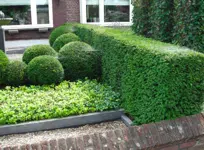
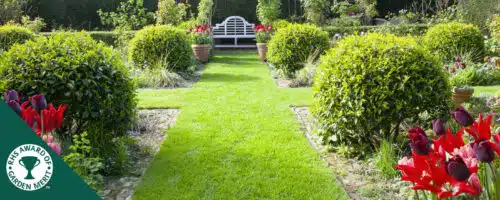
The peacocks in Hidcote Manor’s Fuchsia Garden and in Cliveden’s Long Borders are part of Norah’s trademark style. Her peacocks added a touch of glamour and stood out in winter when the fuchsias offered very little. The Long Borders still contain Norah’s original topiary, although it must be a hundred years old by now. The new Cliveden design, by James Scott of The Garden Company, has added domed yew ‘pincushions’ and beech ‘beehives’ and this an idea that can work in most gardens.
The Cliveden box in the Long Borders, beset by blight and caterpillar, has had to be removed. It’s been replaced by the compact Taxus x media ‘Hillii’, also known as Hill’s Yew. This recent American cross between English yew (T. baccata) and Japanese yew (T. cuspidata) develops golden tints in autumn.
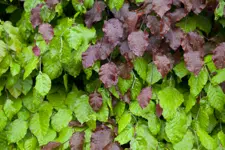
Topiarised beech lends itself to straight-sided topiary because it’s very twiggy. The soft, silky green foliage flatters flowers in spring and summer and then it colours up to orange in autumn. It keeps some of its foliage in winter, as long as it’s cut in August or thereabouts, and these leaves are a warm-brown.
Beech (Fagus sylvatica) needs good drainage to thrive and a bright position. If your soil’s heavy and lies wet in winter, opt for hornbeam (Carpinus betulis) instead. It also tolerates some shade and it comes into leaf before beech. I love to see April and May-flowering tulips in front of hornbeam when it’s just breaking into bud. Beech leaves break a little later and they can be cut into rectangular blocks and spaced regularly throughout flower borders, to give vertical presence and link the ground to the heavens above.
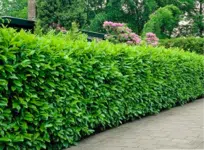
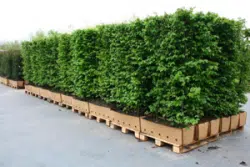
Pleached beech and hornbeam trees are available in several sizes and you can create an instant screen. If you opt for larger pleached trees, which are already trained and fixed on bamboo frames, they will need to be nurtured through their first two seasons. Keep them well-watered in the growing season, if it’s dry, and feed them. Ring the nursery to discuss transport arrangements and suitable feeds.
Norah famously used tall spires and uprights throughout her designs and not just at the back. Silver-leafed verbascums were one of her key plants and they would happily self-seed and provide year-round uprights, because their seed heads endured through winter. She also used the Scotch thistle, Onopordum acanthium, in the same way, for its upright branching silhouette.
Much of the perennial planting in the revamped Long Borders is insect-friendly. There are two new perennials that add vertical presence. The tall columnar yellow daisy Rudbeckia laciniata ‘Herbstonne’ ( still showing yellow in my garden this November) and Verbena hastata ( a late-summer pink candelabra) have proved to be insect magnets. Cliveden’s visitors have remarked upon the number of insects, bees and butterflies visiting the long borders during the exceptional summer of 2025.
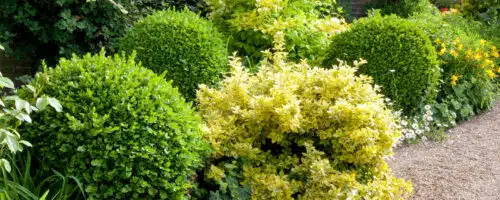
Gardeners are all looking for green-leaved plants to replace rounded box balls, which many have lost and others have removed. Climate change has definitely altered my thinking on this one. Twenty years ago, I wouldn’t have dreamt of mentioning pittosporums as an alternative because I used to think that this New Zealander was too tender. These days I see it thriving in my very cold Cotswold village, 700 feet above sea level.
Positioning is key with pittosporums, because they need protection from cold easterly winds and from early morning sunshine that thaws out frost quickly. The quick thaw ruptures the cells of plants and that does the damage and can kill plants. If you give your pittosporums a southerly or westerly position, you’ll avoid that damaging quick thaw that also does for early-flowering magnolias and camellias.
North-facing positions, which are very sheltered in many gardens, are too shady for pittosporums. The lack of sunlight promotes looser, straggly growth. Full sun, or a bright position, are essential for most New Zealand plants. Brighter positions produce bushy growth and regular clipping is needed in milder areas of the country. The topiarised ones in my chilly village are clipped in summer and they always look glorious in winter light.
You must also avoid frost pockets. They generally lurk at the lower end of your garden, along with water in the ground. Given all that, P. tenuifolium is the hardiest pittosporum of all, because it’s found in various locations and altitudes on North and South Island. It’s often grown by florists in New Zealand, because it has a long vase life and it’s also fragrant in May and June, when the tiny flowers appear.
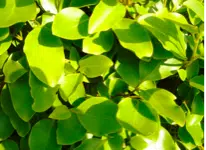
The species has dusky-green shiny foliage with wavy edges, held on black stems and they add a touch of sleek sophistication. ‘Abbotsbury Gold’ has green and yellow tones in the foliage and casts its own sunlight.
Flower arrangers love ‘Irene Paterson’. The dark stems support white leaves speckled in green and, as the season wears on, the leaves develop more green. These slower growing pittosporums make excellent container plants.
The naturally mound-forming, compact ‘Golf Ball’ is a definite candidate for box replacements and it won’t need regular pruning. The mint-green foliage is small and oval, with a paler midrib. It would be possible to edge a border, or create cloud-like clusters, or to space out small pincushions. ‘Silver Ball’ arose as a sport of ‘Golf Ball’ and it has an irregular silvery white edging to each leaf. This contrasts with the black stems and it is another popular flower arranger’s choice. It will reach 2m in height., possibly 3m in warmer parts of the UK.
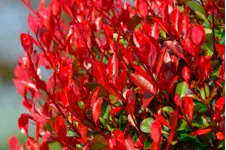
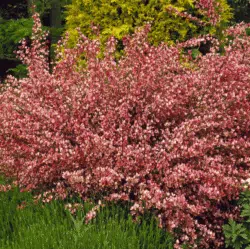
‘Tom Thumb’ is smaller, reaching 73cm on average, but the new foliage is a vivid green above mature dark almost-black foliage and there are shades of deep-red too. It’s a little Marmite, but a really good plant never the less. ‘Elizabeth’, known as Kohouhu, is perhaps the most popular with flower arrangers, because the variegated cream and green foliage develops a pink edge that seem to run into the leaf like ink on blotting paper. They’ll all act as winter warmers at this time of the year.

Looking to spruce up your garden this year and need some new ideas? Discover our predictions for the top 2026 gardening trends in the UK below – set to focus on sustainability, smarter use of space, and creating gardens that support both people and wildlife. Top 5 Biggest Gardening Trends For 2026 1. Native planting:…
I’m a lifelong organic gardener and, I always say, it’s for all the wrong reasons. I grew up in the early, cash-strapped 1950s, when gardens were not exposed to a barrage of chemicals. There weren’t many products to buy, but most couldn’t afford them anyway because the household budget was strained. My organic mentor was…

As we creep towards the shortest day a certain sort of magic descends. Low light slants through the garden and picks up all the detail of line, texture and silhouette. I noticed this many years ago when I gardened in Hook Norton on Oxfordshire. All the older gardens had the same sturdy giraffe-like cooking apple…