***GET AN EXTRA 10% OFF SALE PRICES WITH CODE FLASH10, ENDS FRIDAY***
***GET AN EXTRA 10% OFF SALE PRICES WITH CODE FLASH10, ENDS FRIDAY***




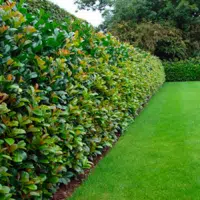
 https://www.hopesgrovenurseries.co.uk/wp-content/uploads/2022/09/mixed-native-hedging-3-750x563.jpg
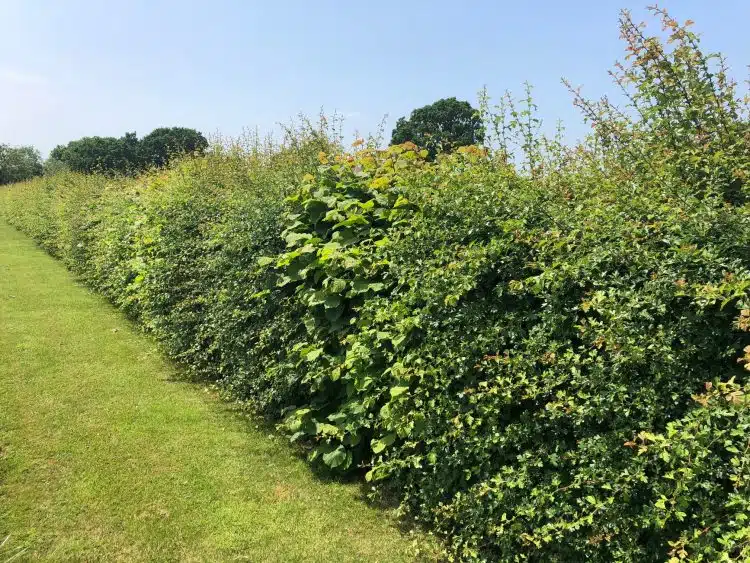
You can make a tremendous difference to the wildlife in your garden by planting eco-friendly hedging. You’ll provide nesting sites, if you allow your hedges to develop thickly and only lightly trim them in winter. There’ll be blossom for bees and wasps in spring and by autumn they’ll be fruitful hips and berries to sustain your birds over the winter months.
They will visit and stay in your garden and you’ll reap the benefits. Most nesting birds collect insects when they have fledglings in the nest, so aphids and other grubs will disappear down their gullets. Wrens, dunnocks and robins, and all birds with pointed narrow beaks, will carry on collecting the insects and small grubs in your garden throughout the year. Pollinating insects will visit the flowers and that will add fecundity to your garden and ensure heavier fruit crops, more beans, more flowers and lots of seedpods. It’s win and win – but please don’t use insecticides. They’ll kill all soft-bodied creatures and that has a knock-on effect on the creatures you love – including (among others) hedgehogs and garden birds.
The best wildlife hedges contain native plants or flora, because they have evolved alongside our native fauna or wildlife for millennia. This link between the two was really brought home to me when I found a lacewing larva in my garden some twenty years ago. Lacewing larva feed on aphids, but they will also eat whitefly eggs, thrip larvae, scale insect, mealybug and young caterpillars. The winged adults are normally found feeding on honeydew in the tree tops, particularly on lime and sycamore, in my experience. It’s rare to spot one their larvae on perennial plants. They have ridged pale-brown bodies and quite hairy faces, so Victorian gardeners christened them lacewing lions.
The lacewing larva (or lion) I found was feeding on aphids on two scabious plants and their stems were intertwined. One was our native field scabious, Knautia arvensis, a blue pincushion scabious common on verges particularly in limestone areas. I use it in the garden borders because it’s very long-flowering, beginning in June and stopping in late summer. It attracts lots of pollinators as well. I can tug this wild scabious out in July, when it gets a bit ragged, and it will rebloom in autumn. Don’t try this with the maroon-flowered Knautia macedonica though. It doesn’t come back when tugged out in midsummer – so there’s a maddening gap as I found to my cost!
The blue field scabious on verges I spoke about, K. arvensis, is becoming rarer in the wild because the seeds are spread by ants and they’re not great spreaders. These tiny creatures only take them a couple of feet or so. Ants often roll seeds about, to take advantage of the sticky seed coating, before they discard them. They do this with cyclamen seeds – much to my frustration – because they pop up where I don’t want them. The technical term for ant rolling is Myrmecochory and I’m not making this up!
To go back to my lacewing larva. I watched in awe as my lacewing lion tossed up aphid after aphid and I knew it needed to be photographed. There was a problem, it was in tangle of stems and that made a clear picture an impossibility. The stems of Knautia arvensis were tangled with an alien scabious with showier blue flowers, Scabiosa caucasica. This flowers later and that’s why I grew them so close together. After all, I am a fully paid-up member of the Shoehorn School of Gardening. I began to slowly untwine the stems, very carefully, having summoned the Best Beloved for his photographic skills. Finally, the lacewing larva was in full view on one stem. That’s when I noticed that all the aphids were on the native Knautia arvensis stems, with none of the alien Scabiosa caucasica. These sap-feeding creatures had colonised the native and ignored the alien.
You may think that having aphids in your garden isn’t very desirable, but it is. It’s the tiny creatures in your garden that sustain the other creatures and that might include flies, spiders, birds, wasps, scorpion flies, beetles and so on. Follow the food chain up (or the food web out) and you’ll find thrushes and hedgehogs too. Aphids are one the of the foundation layers of a food web, or eco-system, and all of our tiny creatures are in short supply. If you can think back to the 1990s you will recall having to clean your windscreen every week or so during the summer, because lots of tiny insects had stuck to it. It’s not the case now, sadly, and that helps to explain why our bird life has plummeted. Many can’t find food for the baby birds.
We are in a sorry state. Britain has lost 73 million birds over the last 50 years, according to the Natural History Museum. Farmyard birds have declined by 60% since 1970, due to changes in farmland management. Pesticide use and the removal or scalping of hedges are partially responsible. The decline’s speeding up too. In the five years, between 2015 and 2020, 48% of bird species have shown a decrease. Planting a wildlife hedge containing native plants will help to reverse this and it is possible to do it! Individual actions matter and gardeners can create their own personal eco system. 
Hawthorn is the king of hedging plants when it comes to wildlife. The haws provide a valuable food source for many small birds and insects, including thrushes, hawthorn shield bugs and yellowhammers. The dense thickets provide shelter for small mammals such as wood mice and are they used by birds as nesting sites. Sloe worms often shelter there too. When the blossom’s out it satisfies honey bees, flies and solitary bees. Hawthorn’s a butterfly and moth foodplant too. In theory it could also attract 149 species of insect in Britain and it’s in fourth place behind oak (284), willow (266) and birch (229) when it comes to pulling in the wildlife.
Crataegus monogyna, sometimes called common hawthorn or quick thorn, could be planted on its own, or with other natives. Hope Groves has an Edible Hedge Mix that also contains Common hazel (Corylus avellana) and this will provide catkins in spring, and hazel nuts in autumn. It’s an invaluable plant for gardeners, because the pliable twiggy stems can be used to support plants. The leaf litter is dry and spring bulbs, especially snowdrops, love pushing up through a carpet of papery hazel leaves shed last autumn.
The Woodland Trust – www.woodlandtrust.org.uk – tell us that hazel leaves provide food for the caterpillars of moths, including the large emerald, small white wave, barred umber and nut-tree tussock. The nuts, which are usually taken by squirrels in my garden, could feed mice, dormice, woodpeckers and jays. We are way down the pecking order.

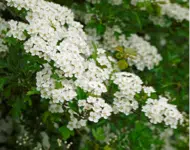
Prunus spinosa, commonly called blackthorn or sloe, is also included in the Edible Mixed Native Hedge collection. There are thorns, as the name spinosa implies. The pollinator-friendly white blossom appears in April and is often associated with cold conditions and a period known to countryfolk as the blackthorn winter. The dark-blue sloes are used to make sloe gin, but you have to be quick off the mark for they are very popular with the birds. Sloe gin needs ripe fruit, that’s soft to the touch, so it’s a race against time. You need to get there before they do.
Blackthorn is good for other wildlife too. Caterpillars of the lackey, magpie, swallow-tailed and yellow-tailed moth feed on the leaves and black. Black and brown hairstreak butterflies lay their eggs close to the branching stems, because their caterpillars feed on the newly emerged foliage.
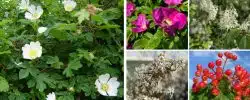
The Native Hedge mixture contains 25% hawthorn, 25% hazel and 25% sloe. The other 25% contains some dog rose (Rosa canina) and their single-pink flowers are bee magnets in June. Large red hips follow and they are eaten by many birds, including finches, blackbirds, tits and thrushes. When planting, a double row will form a thicker hedge more quickly. Use 5 plants per metre, setting the plants 16inches /40cm apart in each row with 40cm between the 2 rows. For a thicker hedge use 7 plants per metre and space them 11inches/28cm apart in each row with 40cm between the 2 rows.
The Bird Friendly mix also contains spindle, Euonymus europaeus. It’s my favourite, because the leaves turn to shades of red in autumn and they drop soon after to reveal the curious orange and pink spindle berries. Each one forms a carousel of bright-pink with dangling orange seeds that seem to lean outwards like fairground swings in full pelt. I can still remember the first time I ever saw one as a teenager, for I came from the city. I just stood and stared at the spectacle, open mouthed.
The straight twigs were used as spindles for spinning, holding wool, skewers, toothpicks, pegs and knitting needles, hence the common name. The fruits were baked and powdered and used to treat head lice, or mange in cattle. It’s a case of don’t try this at home though, for the purgative leaves and fruit are toxic to humans.
The leaves are eaten by some moth caterpillars including the magpie, spindle ermine, scorched carpet and a variety of micro moths, as well as the holly blue butterfly. The small, yellow-green flowers are full of pollen and nectar in May. The green flowers attract flies and often have a musty smell.
The fruits are highly nutritious for birdlife, the most calorific of any autumn fruit. Robins adore them and fight to keep other birds away from their prized spindle bush. Male robins are very aggressive and it’s said that 10 per cent of older robins die defending their territory. They will protect their spindle tree with their life, if necessary. It’s worth having a spindle for your robin, for he or she will sing through the dark days of winter. They’re saying stay off my patch and leave my spindle bush alone.

I’m a lifelong organic gardener and, I always say, it’s for all the wrong reasons. I grew up in the early, cash-strapped 1950s, when gardens were not exposed to a barrage of chemicals. There weren’t many products to buy, but most couldn’t afford them anyway because the household budget was strained. My organic mentor was…
As we creep towards the shortest day a certain sort of magic descends. Low light slants through the garden and picks up all the detail of line, texture and silhouette. I noticed this many years ago when I gardened in Hook Norton on Oxfordshire. All the older gardens had the same sturdy giraffe-like cooking apple…

We are one of just a handful of online nurseries to have attained Plant Healthy certification. In a nutshell, it’s a way of proving that we will always do the right thing in preventing the spread of harmful plant pests and diseases. The Plant Healthy Management Standard is a voluntary initiative that sets out requirements…