10% OFF SALE PRICES WITH CODE EXTRA10 – ENDS MIDNIGHT SUNDAY
10% OFF SALE PRICES WITH CODE EXTRA10 – ENDS MIDNIGHT SUNDAY




 https://www.hopesgrovenurseries.co.uk/wp-content/uploads/2022/09/yew-english-2-1.jpg
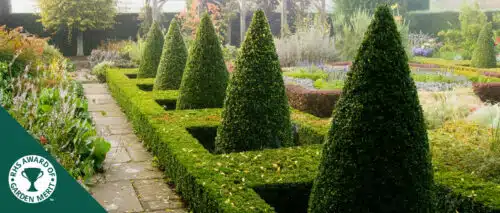
At the end of the month the clocks go backwards and, just like everything, it’s a mixture of good and bad. The extra hour in bed is always handy, but the darker evenings aren’t quite as welcome. There are changes afoot outside, because the froth of summer is disappearing underground as the temperatures fall. On the plus side, the bones of the garden are beginning to emerge and evergreens, those lovely winter warmers, are taking centre stage – be it topiary, specimen or hedging. They will carry the garden through winter and into spring, giving the garden an evergreen glow.
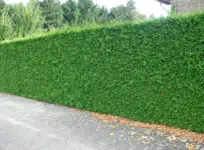
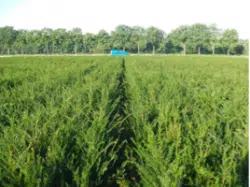
Evergreens offer extra privacy and noise reduction and this is particularly important in urban areas. Luckily, yew tolerates pollution. Yew has another trick up its sleeve. It’s able to grow back from bare wood, a unique trait among conifers. So, if you have to cut it back to bare wood, it can and does rejuvenate. Best to tackle it in two stages and do one half first.
Grown as a hedge, yew only needs a yearly trim, ideally between August and late September. This late-summer cut gives it a sharp edge for the winter months. However, yew trees and hedges can be trimmed up until March. Many gardeners shy away from planting yew and I’ve been one of them, I am ashamed to say. I convinced myself, way back when, that a yew hedge would take decades to reach a reasonable height. It’s completely wrong. It’s quite possible to get a decent yew hedge within eight years, as long as you prepare the soil well, feed your hedge during the growing season and trim the young plants correctly.
Pruning New Yew Hedging
Prune the sides, but leave the tops alone until they reach about a foot below your desired height. If you trim them earlier, it will stunt the plant. The other tip is to allow the lower branches to grow wider than the upper branches, because this slightly A-shape allows more sunlight to reach the foliage. As the meerkat said – simple!
Is Yew Poisonous?
Yews produce red fruit and the fleshy part, known as the aril, is edible and (apparently) tastes sweet. I don’t recommend trying them though, for the black seeds (protected by the red aril) are poisonous. Birds devour the red fruits and the seeds pass through them (without harming them) and then they germinate. The bird dropping provides them with extra food. I have some self-sown yew that’s now ten feet tall and they reached that height in less than fifteen years and the soil there is impoverished.
Which Yew’s for You?
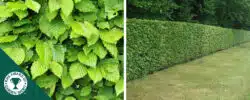
English yew hedging (Taxus baccata) has rich green foliage that’s soft to the touch. It’s the one found in churchyards and some of the trees have been carbon dated and they can be thousands of years in age. Dating ancient yews accurately is difficult because the heartwood dies out once the trees are veterans. The Fortingall Yew, in Perthshire in Scotland, is said to be the oldest yew tree in the UK, according to The Woodland Trust. Some reports say that it’s 5,000 years old.
Time has ravaged this veteran yew tree. When it was first described in 1769, the Fortingall Yew’s girth measured 16 metres (52 feet). These days it’s much smaller. The trunk has split into several parts, and funeral processions pass through the arch formed by the split trunk. Others veteran yews have romantic associations. Henry VIII and Anne Boleyn secretly met each other in the shelter of the Ankerwycke Yew in Berkshire during the 1530s. It’s just across the river from Runnymede.
The Druids revered this tree’s longevity and its ability to regenerate from bare wood. Early Christian associated the tree with the resurrection and death and yews are found in churchyards more than any other ancient tree. St Mary’s Church in Painswick boasts 99 trimmed yews, most roughly 200 years old. It’s said that the devil would destroy the hundredth yew and this was put to the test when every parish in Gloucestershire was given one yew tree to plant in 2000. Painswick’s millennium yew is still doing well, so far so good.
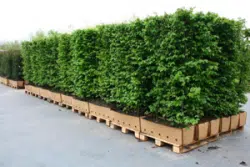
Hopes Grove’s yews, sold for hedging, are available in bare root, containers, troughs, and root balls. Pot sizes and heights vary. You will need 2 -3 per metre, depending on which size you buy. If you want an instant hedge and you opt for larger plants, bear in mind that you have to be prepared to water regularly in our drier springs and summers. Smaller plants are easier to establish, but sometimes you need an instant hedge.
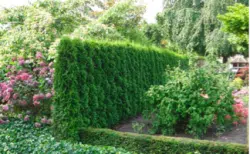
Irish yew, Taxus baccata ‘Fastigiata’, is much columnar in shape so hedges tend to be narrow in width, but need little or no pruning. They are often used to line drives or where space is tight. There is a golden form of Irish yew that could lighten up a darker space. Golden yews grow more slowly, but they may be more drought tolerant – although this is my supposition. Please consult the oracles on the nursery.
English holly, Ilex aquifolium, is a slow-growing prickly beast – the Victor Meldrew of the plant world. There are occasions when prickly is good, for security reasons for instance. There is a clue in the species name for aquifolium translates as foliage like an eagle’s talons. Samuel Pepys (1663 – 1703) wrote about John Evelyn’s holly hedges at Sayes Court in Deptford in London commending the ‘variety of evergreens and hedges of holly, the finest things I ever saw in my life.’ Evelyn described them as ‘most boscaresque’ – although I’m not sure if that is the same as bosky – meaning covered with trees and bushes. Evelyn’s tall hedges kept the cruel easterly winds away from his plants.
Saye’s Court’s hedges were put to the test by more than cold wind s when Peter the Great of Russia rented the house for his three-month visit to the naval dockyards. The Tsar, plainly not a gardener, held roisterous drinking parties and took to pushing his friends through the four hundred feet long hedge, using a wheelbarrow. Mike Paterson’s 2014 article on John Evelyn, posted on London Historians’ Blog, quotes Evelyn. ‘Is there under heaven a more glorious and refreshing object of the kind, than an impregnable hedge of about four hundred feet in length, nine foot high, and five in diameter; which I can shew in my now ruin’d gardens at Say’s-Court, (thanks to the Czar of Muscovy) at any time of the year, glitt’ring with its arm’d and varnish’d leaves? The 17th century house, gardens and hedges are no more, although there is a Saye’s Court Park, not far away from a very unflattering sculpture of Peter the Great.
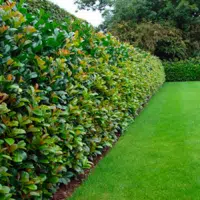
I’d recommend a rounder-leafed holly, kinder holly that was first identified at Highclere Castle near Newbury, now famous as the setting for Downton Abbey. It’s named Ilex x altaclerensis (literally the house of Clere) and it came courtesy of the birds. Highclere’s orangery contained a tender holly from the Canary Islands, Ilex perado, grown for its lavish foliage. The large hand-sized leaves are rounded and a high-gloss green. The citrus trees and hollies at Highclere Castle were moved outside in summer and it’s thought the bees carried pollen from this tender holly to the female flowers of our native prickly holly growing wild in Highclere’s woods.
Rounder-leafed seedlings appeared and they were identified by John Loudon who called them Highclere hollies. Ilex perado was introduced in 1760 and more of these hybrid seedlings were identified in other places. They all have rounder foliage, that isn’t prickly, and the females produce larger berries although there are fewer of them. Holly has female and male flowers on separate plants and pollen needs to travel between them in most cases. The females produce berries, but the names plant raisers use can be misleading.
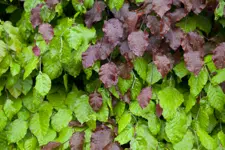
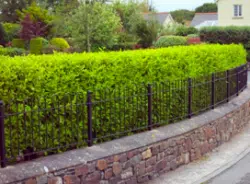
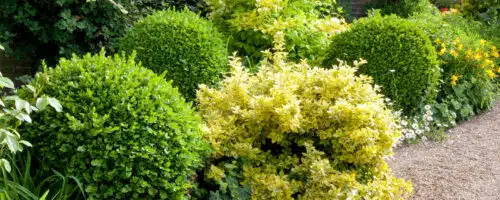
One of the best is ‘Golden King’, a female berrier despite its name. The oval foliage has a dark-green middle, splashed in grey-green, and the broad, irregular margin is creamy yellow. This is the best one to clip and shape, because the growth habit is denser. It makes a dense hedge and is faster groing than English holly.
Christopher Bailes’s excellent book, Hollies for Gardeners, tells us that ‘Golden King’ arose as a sport of ‘Hendersonii’ at the Bangholm Nurseries in Edinburgh in 1884. You can get brighter-leafed ones with more yellow including ‘Lawsoniana’, another sport from ‘Hendersonii’, found at William Hodgson’s nursery in County Tipperary in Ireland in 1874. The yellow-margined green foliage of ‘Belgica Aurea’, a 1908 Dutch introduction, is neater and crisper to look at and it also berries.
Bear in mind that neatly trimmed holly edges don’t get much chance to produce berries. However, their leaves are wonderful, lighting up the winter months.
Looking to spruce up your garden this year and need some new ideas? Discover our predictions for the top 2026 gardening trends in the UK below – set to focus on sustainability, smarter use of space, and creating gardens that support both people and wildlife. Top 5 Biggest Gardening Trends For 2026 1. Native planting:…
I’m a lifelong organic gardener and, I always say, it’s for all the wrong reasons. I grew up in the early, cash-strapped 1950s, when gardens were not exposed to a barrage of chemicals. There weren’t many products to buy, but most couldn’t afford them anyway because the household budget was strained. My organic mentor was…
As we creep towards the shortest day a certain sort of magic descends. Low light slants through the garden and picks up all the detail of line, texture and silhouette. I noticed this many years ago when I gardened in Hook Norton on Oxfordshire. All the older gardens had the same sturdy giraffe-like cooking apple…