10% OFF SALE PRICES WITH CODE 10MORE – ENDS TONIGHT
10% OFF SALE PRICES WITH CODE 10MORE – ENDS TONIGHT




 https://www.hopesgrovenurseries.co.uk/wp-content/uploads/2024/05/Euonymus-Green-Spire-18-12-25GAP-1770614-Copy-3-750x501.jpg
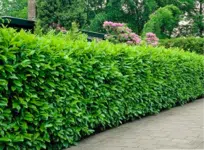
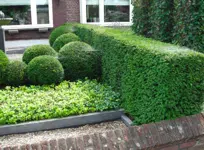
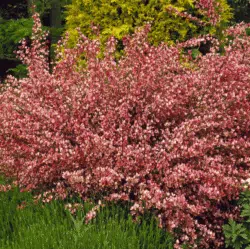
EUONYMUS USED AS AN ALTERNATIVE TO BOX HEDGING
https://www.hopesgrovenurseries.co.uk/wp-content/uploads/2024/05/Euonymus-Green-Spire-18-12-25GAP-1770614-Copy-3-750x501.jpg
EUONYMUS USED AS AN ALTERNATIVE TO BOX HEDGING
I’m a regular attender at our local waste recycling tip, because my low-slung cottage has very little storage space. There’s no loft or garage here. And this year I’ve been sorting out piles of stuff, because we’ve been here for twenty years. Whenever I have any garden, or shed waste, I’m forced to make a visit and I’m astonished by the amount of discarded box bushes in the skip. It’s all too evident that lots of gardeners are throwing in the towel, when it comes to box, and looking for alternatives. My daughter lives in a suburban street and it’s the same picture there.
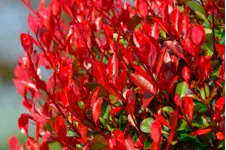
Many gardeners, faced with these two problems, are looking for an evergreen alternative to box. Euonymus fortunei would be perfect for a low hedge and it comes in several colourways, from gold and green, to silver and green, to rich-green. These colourful shoots probably arose as ‘sports’, a term for a new shoot that’s different from the parent. Lots of evergreens do this and many ivies have arisen this way, as sports. Just like ivy, the adolescent growth of this euonymus is barren so there are no berries or flowers – just leaves. However, both produce flowers and berries on the adult, or arborescent, growth.
This Chinese shrub, Euonymus fortunei, was originally collected by the Scottish botanist and plant hunter Robert Fortune (1812- 1880). It’s extremely hardy, which is unusual for evergreens, and it tolerates different soils and sun or shade. Evergreens are an important element in any garden. They light up winter, because they stay in leaf, and the foliage also provides shelter for lots of insects such as spiders and hibernating ladybirds. Every garden needs some evergreens and the foliage of E. fortunei is neat and small so this evergreen can be used in small spaces, in containers or as hedging.
Fortune is credited with collecting and introducing 250 ornamental plants, including this one, in the days when plant hunting was highly risky, especially in China. Fortune adopted Chinese dress, masquerading as a mandarin, in order to go under the radar. He shaved off his hair and wore a wig and a pigtail, a necessary ruse because foreigners were considered unlucky in rural areas. They were often mugged near cities and towns. Fortune’s elaborate Chinese robes hid anything he acquired and he entered forbidden zones of the country, accompanied by his servant Wang.
Fortune was as much a spy as a plant hunter. He was sent to China to collect the plant used in tea making, Camellia sinensis. The Chinese had a monopoly and tea was an incredibly expensive luxury for the moneyed classes. China was making a lot of money out of us. Fortune was financed by the East India Company, so that he could bring back plants, but he also poached skilled tea makers, growers and blenders. Unfortunately, most of Fortune’s plants perished. However, the people proved vital and tea was eventually grown in Sri Lanka and Assam by the late 19th century, due to their skill and knowledge.
If you want to create a splash of sunshine ‘Emerald n’ Gold’ AGM will reach almost two feet in height. The grey and grey-green foliage is bordered in golden-yellow and it shines in winter light often developing reddish pink tones in colder weather. This American plant was raised in the USA in 1967. If you want a cooler combination, opt for ‘Emerald Gaiety’ AGM, another American raised plant also from Corliss Bros of Massachusetts. The grey -green, broader leaves have an irregular silvery white edge and this is very bushy when grown as a low hedge.
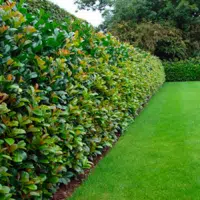
Euonymus japonicus, known as the Japanese spindle, is a taller evergreen with larger rich-green leathery leaves. This will form hedges between four and six feet in height. You’ll also get flowers and berries, although regular pruning in late spring will prevent flowering like as not. Japanese spindle is very tolerant of position and soil, although it can get some mildew in drier summers. This is not critical. Mildew is a water stress disease. Most named forms have been raised in Holland or Germany.
The brightly variegated ‘Marieke’ (correctly called ‘Ovatus Aureus’) has been grown in gardens since the 1840s. The dark-green foliage is liberally edged, blotched and splashed in golden-yellow. It needs a bright position to keep its vivid yellow colouring.
‘Bravo’ is a Dutch-raised euonymus with an almost pyramidal shape and the glossy green foliage has an irregular creamy white margin. It has a mysterious past, because it was found growing in a Dutch garden under the incorrect name of E. americanus in the 1980s. It’s a subtler option.
If you want a plain green slow-growing one, try ‘Jean Hugues’. It will grow about eight inches a year (20cm) until it gets to one metre in height. This is the most box-like option because the slightly serrated leaves are similar in size. The young growth is always a paler green, so it’s an attractive evergreen.
‘Green Spire’, which has a similar growth habit to ‘Jean Hugues’, has a more upright habit. Both of these green-leafed euonymus develop a brighter colour in good light. Trim them twice a year, in May and late summer, so that they look smart and crisp during the winter months. ‘Green Spire’ is often used in famous Japanese gardens, as an infusion of green, and it was introduced from Japan into the US National Arboretum in 1978.
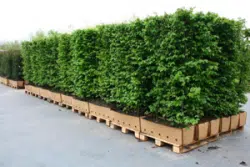
These rich-green evergreen spindles make excellent box substitutes and you have two height options, the taller Japanese spindle and the shorter Fortune’s spindle. I think we’ll find more and more of them being planted in years to come, because they’ll stay looking healthy and vigorous.
Some General Box Advice
If you’re still struggling with box, it’s important to identify the two main problems – box caterpillar and box blight.
Box blight is caused by two closely related fungi, Calonectria pseudonaviculata and Calonectria henricotiae (syn. Cylindrocladium buxicola). It defoliates box bushes and creates a twiggy mess of almost-white bare stems. The foliage never grows back. However, the fungus doesn’t go travel into the roots, so I’m told. If you can cut the box right back to the ground and destroy the top growth it will grow back healthily from the base as long as there are no infected spores left on the ground. Mulch may help to prevent reinfection, because any surviving spores can’t bounce upwards in wet weather.
There are box products on offer to keep box healthier and seaweed feeds are very effective. Variegated box, Buxus sempervirens ‘Elegantissima’ seems to be able to resist box blight and it’s also more drought tolerant, as most variegated plants are. It prefers a sunnier site and it’s tastefully variegated, although some might think that an oxymoron.
Shape matters too, when it comes to preventing box blight. If your box hedge or topiary has a flat level top the water tends to sit on the foliage, and that encourages box blight because fungal diseases thrive when warmth and moisture are present. Any box shape that allows water to cascade downwards will be less prone to blight. You could create a hedge of roundels, or egg shapes. It doesn’t have to be a level parterre. Tripods, spirals and cones also shed water really well.
It’s important to clean up every time you clip. Place some horticultural fleece or newspaper on the ground so that you can pick up every snippet. I find that the tidying often takes longer than the clipping, because you also need to tease the tiny cut pieces out of the box. I have my own dedicated battery-operated cutter for my own box, because the disease spreads from garden to garden on tools.
Box caterpillar moth (Cydalima perspectalis) is equally disfiguring. It creates patches of damage and it’s eradicated the beak of one of my box chickens this year! It’s completely missing. I have two box chickens, but the oh-so-pretty moths prefer the one that’s in the lee of the fruit trees, to the one in full sun. Perhaps the foliage is moister and lusher when it’s slightly shady. There are chemicals that stop the caterpillars feeding, but birds will also clear them up for you. Jackdaws cleared the caterpillars in the National Trust’s Ham House Garden near Richmond in Surrey. There were two broods, one in June and one in August, and both went into the beaks of jackdaws. The green caterpillars are hard to find, but the white webbing protecting the young caterpillars is easy to spot – although I must have missed it this year! Luckily box recovers from caterpillar attack. If it’s severe there is a caterpillar killer called DiPel, although it is expensive.


Looking to spruce up your garden this year and need some new ideas? Discover our predictions for the top 2026 gardening trends in the UK below – set to focus on sustainability, smarter use of space, and creating gardens that support both people and wildlife. Top 5 Biggest Gardening Trends For 2026 1. Native planting:…
I’m a lifelong organic gardener and, I always say, it’s for all the wrong reasons. I grew up in the early, cash-strapped 1950s, when gardens were not exposed to a barrage of chemicals. There weren’t many products to buy, but most couldn’t afford them anyway because the household budget was strained. My organic mentor was…

As we creep towards the shortest day a certain sort of magic descends. Low light slants through the garden and picks up all the detail of line, texture and silhouette. I noticed this many years ago when I gardened in Hook Norton on Oxfordshire. All the older gardens had the same sturdy giraffe-like cooking apple…