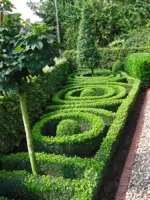
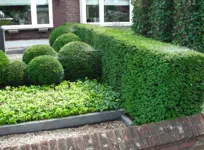
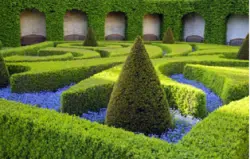
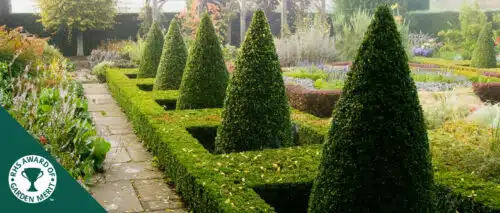
English Yew or Taxus baccata has long been used in the practice of topiary or clipping of shrubs to a specific architectural shape. The close-knit foliage when trimmed by the expert hand can give the finishing element of luxury to a straightforward hedge or garden design. Dating back to Roman times and perhaps earlier, the word topiary is derived from the Greek topiarius or creator of topia or places, the art went out of fashion only to be revived in the 17th and 18th centuries for some of the dramatic designs to be found in the gardens of country houses and estates.
Requiring a steady hand and a sharp pair of shears, the English Yew Topiary Cube shapes also need a good eye for symmetry as they require trimming each year to sharpen the edges of the plant from the fronds of new growth. The straight sides and sharp corners of the Cube shape make precision particularly important, as even a small amount of uneven growth can alter the appearance of the finished form. Where several Cube Shapes are included in the planting, extra care needs to be taken to keep them all at the same dimensions, although different sized cubes can also be used together to create a more varied and contemporary effect.
English Yew Topiary Cubes do have the advantage that as a slow growing plant at between 15-30cm per year, trimming is not so much of a problem as perhaps with other plants and is one of the most elegant subjects for shaping as it can give such a smooth appearance to the finished form. The dense foliage of the Yew responds particularly well to clipping and, with regular maintenance, the individual planes and corners of the Cube can be kept clearly defined. Trimming would normally be done in autumn, removing the softer new growth and maintaining the established shape of the plant.
For those who wish to take the easy option, rather like a pre-tied bow tie, it is possible to buy a frame through which to grow the English Yew and trim to the frame, thus getting the shape and dimensions correct. This can be particularly useful when creating several matching Cube Shapes as it helps to maintain the same proportions and gives a consistent appearance throughout the planting scheme.
Grown in containers or planted directly into the garden, English Yew requires reasonable soil with good drainage as it is not happy sitting in wet soil for any length of time. Once established it provides reliable evergreen foliage throughout the year, making it particularly valuable where a formal garden design needs to retain its structure and definition during the winter months.
The strong geometric lines of English Yew Topiary Cubes make them particularly effective when used to frame entrances, define pathways or provide symmetry either side of doors, gates and garden features. They can also be used individually as focal points within borders or repeated at regular intervals to create a formal avenue or strong architectural planting scheme.
Container grown English Yew Topiary Cubes are supplied throughout the year giving the option of planting when required and of course they can initially be placed in the pot in situ to make sure the garden design works. If not then it is easy to move them around before planting. This also makes them particularly useful for establishing formal designs where the exact position and spacing of each Cube can be considered before permanent planting.
Whether used individually or as part of a larger formal arrangement, English Yew Topiary Cube Shapes provide a strong architectural element to the garden, combining the timeless appeal of Taxus baccata with the clean lines and symmetry of a carefully maintained geometric form.