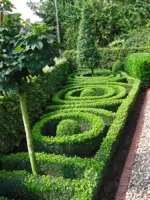
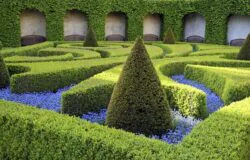
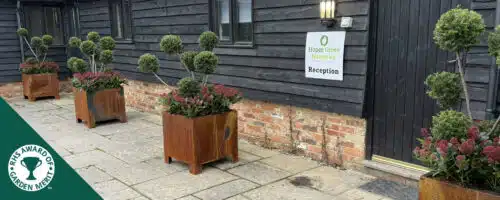
English Yew or Taxus baccata has long been used in the practice of topiary or clipping of shrubs to a specific architectural shape. The close-knit foliage when trimmed by the expert hand can give the finishing element of luxury to a straightforward hedge or garden design. Dating back to Roman times and perhaps earlier, the word topiary is derived from the Greek topiarius or creator of topia or places, the art went out of fashion only to be revived in the 17th and 18th centuries for some of the dramatic designs to be found in the gardens of country houses and estates.
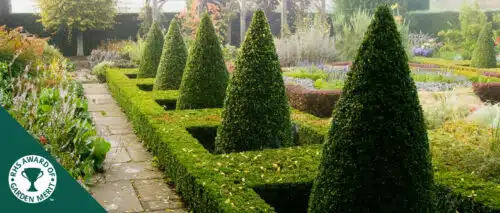
Requiring a steady hand and a sharp pair of shears, the English Yew Egyptian Pyramid shapes also need a good eye for symmetry as they require trimming each year to sharpen the edges of the plant from the fronds of new growth. The sloping sides and pointed top of the Pyramid shape make precision particularly important, as the finished form needs to remain balanced when viewed from all directions. Where several Pyramid Shapes are included in the planting, extra care needs to be taken to keep them all at the same height and proportion, although combining different sizes can also create an attractive and more varied effect.
English Yew Topiary Egyptian Pyramids do have the advantage that as a slow growing plant at between 15-30cm per year, trimming is not so much of a problem as perhaps with other plants and it is one of the most elegant subjects for shaping as it can give such a smooth appearance to the finished form. The dense foliage of the Yew responds particularly well to clipping, allowing the sloping sides and pointed crown of the Pyramid to be kept clearly defined. Trimming would normally be done in autumn, removing the fronds of new growth and maintaining the established shape of the plant.
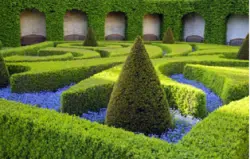
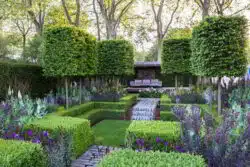
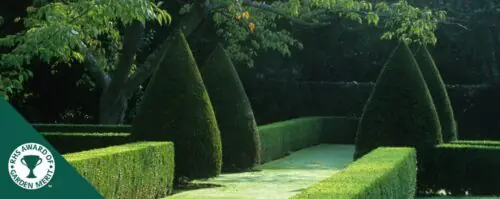
The Egyptian Pyramid form has a particularly strong association with formal and architectural planting, where its upright shape can be used to introduce height without taking up excessive ground space. Planted either side of an entrance, gateway or doorway, matching Yew Pyramids can create a strong sense of symmetry, whilst a single specimen can be used as a focal point within a border or garden design. They can also be planted at intervals along a pathway or formal border to create rhythm and repetition throughout the garden.
For those who wish to take the easy option, rather like a pre-tied bow tie, it is possible to buy a frame through which to grow the English Yew and trim to the frame, thus getting the shape and dimensions correct. This can be particularly useful where several matching Pyramid Shapes are required as it helps to maintain consistent proportions and ensures that the sloping sides and apex remain symmetrical.
Grown in containers or planted directly into the garden, English Yew requires reasonable soil with good drainage as it is not happy sitting in wet soil for any length of time. Its evergreen foliage provides year round colour and structure, making it particularly valuable in formal gardens where the architectural framework of the planting needs to remain visible throughout the winter months.
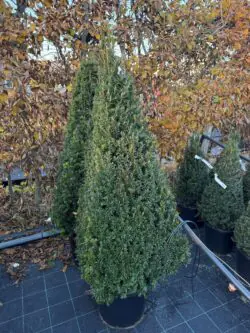
Container grown English Yew Egyptian Pyramid Shapes are supplied throughout the year giving the option of planting when required and of course they can initially be placed in the pot in situ to make sure the garden design works. If not then it is easy to move them around before planting. This makes them particularly useful when planning formal arrangements, as their final position and spacing can be considered before permanent planting.
Whether used individually or as part of a larger formal arrangement, English Yew Egyptian Pyramid Shapes provide a striking architectural element to the garden, combining the timeless evergreen qualities of Taxus baccata with the distinctive upward lines and symmetry of this classical topiary form.