20% OFF SALE PRICES WITH CODE 20OFF – ENDS TONIGHT!
20% OFF SALE PRICES WITH CODE 20OFF – ENDS TONIGHT!





There are lots of occasions when you need a faster growing hedge, whether it’s for privacy, filtering out traffic noise, or for providing shelter from the prevailing winds. In the 1960s, everyone turned to the Leylandii hedge because it could put on two to three feet a year. It had one huge disadvantage though, you couldn’t cut into dead, brown growth because it didn’t regenerate. Once unsightly brown growth appears on Leylandii, it’s there forever. Yew is the only conifer able to grow back from dead wood.
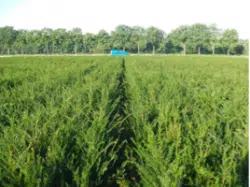
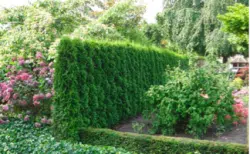
Leylandii hedging needs to be kept in check with a regular trimming in August. That’s the best time, because the growth spurt has slowed down and many hedges, including yew and beech, are best done then. However, garden owners often failed to do this. Once the hedge got too tall, it was an impossible task because Leylandii hedging can reach up to 30m in time. Many a neighbourhood dispute has centred around these trees, because this dense hedging excluded light. Two metres is the recommended height, for good neighbour relations, and that’s the perfect height for most hedges because the sun can rise above them. Leylandii also has a shorter lifespan than many hedges, only living an average of 25 years.
All fast-growing hedges require maintenance because they put on a couple of feet a year. They should be planted in prepared soil and given a balanced feed. Evergreens benefit from After Plant, a bio-active fertiliser with Rootgrow, nitrogen fixing bacteria and seaweed. Deciduous hedging benefits from NPK 7-7-7 such as Growmore.
It’s also a good idea to mulch a newly planted hedge, to preserve moisture in the soil. Apply your mulch after rain once the temperatures have begun to rise to 10C or so.
If you allow grass clippings to rot down and go brown, they can be used because they are mostly decomposed. You can also use garden compost, but you must keep the ground weed-free. Don’t mulch dry ground or very cold ground. Watering is also vital in the first growing season, until the roots get established. Tipping a bucket carefully over the ground is far more effective than dribbling the hose over the ground. Any woody plant benefits from being watered like this in its first year, if rainfall is scanty.
The Most Popular Evergreen for Coast, City, Town or Countryside
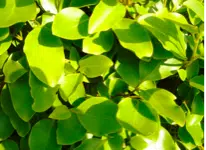
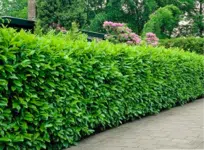
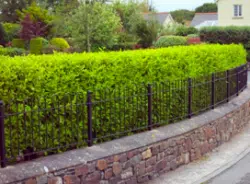
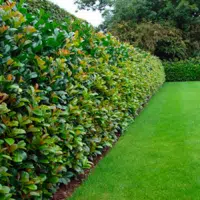
If you want an evergreen barrier cherry laurel, Prunus laurocerasus ‘Rotundifolia’, has rounded bright-green foliage from top to toe. It’s good at screening out noise and absorbing pollution, so this hedge can be planted by the coast, or in city, town or countryside. It’s very hardy as well, but if your garden’s very cold the recently-bred ‘Novita’ is hardier and more disease-resistant. Cherry laurel doesn’t tolerate wet or chalky ground. The leaves turn yellow.
Potted plants of cherry laurel are available, in three sizes, and you can plant bare root as well. Your cherry laurel hedge will put on at least a foot a year and possibly two, and you may have to cut in spring and summer in wetter parts of the country. Hedge trimmers work well on cherry laurel, because the new growth is soft, and there are battery models available. Evergreens are more susceptible to cold weather, than deciduous hedges that lose their leaves, so cherry laurel shouldn’t be trimmed in late autumn or winter. It will provide nesting sites for birds and bees do like the flowers should they appear.
If you’ve inherited an overgrown laurel hedge, it will bounce back after being drastically pruned at the base. You can allow flowers to form and red berries follow and that explains the common name cherry laurel. Do not eat the berries and do get this message across to children, because many red berries are toxic to humans.
More Evergreens
Aucuba japonica, is also resilient after being heavily pruned as was proved when English Heritage’s Brodsworth Hall near Doncaster in South Yorkshire was restored. The original hollies, yews and aucubas planted in the 19th century. Were all given brutal treatment in stages. This garden contains lots of evergreen topiary, handsome ferns and a Victorian parterre and it’s a great garden to visit – particularly in winter. The Thellusson family, who remodelled the house and gatrden, were involved in a long legal wrangle that used up the family fortune. This inspired Charles Dicken’s Bleak House, a sorry tale of Jarndyce versus Jarndyce.
Aucuba japonica is commonly called spotted laurel or Japanese laurel and it forms a lower hedge of roughly two metres after six years, even in dense shade. ‘Crotonifolia’, a golden variegated female plant, will produce large red berries if male pollen is about. ‘Golden King’ is the variegated male that’s normally used. The leaves of both are heavily spotted in yellow. Both will light up dark spaces and positively glow in winter light. They may not be quite as fast as cherry laurel, or as popular, but they are very worthy.
Chalky Soil and Coastal Sites
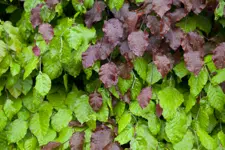
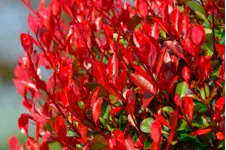
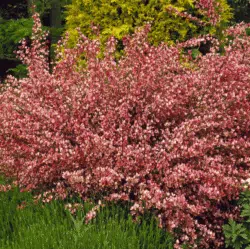
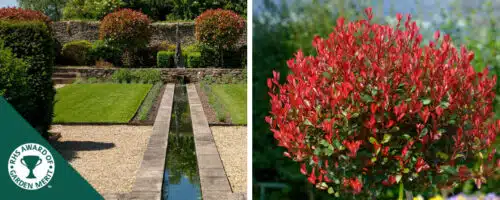
If you’ve got chalky soil, you could grow Photinia because this will put on a foot every year. It will form a slender upright hedge, and it will need pruning twice a year to encourage plenty of new spring growth because this new growth is a very vivid red. You get the best colour in good light, so this can’t be tucked away in shade. Pruning will need doing in spring and summer, because the new shoots need time to harden off before winter. Use secateurs and cut to outward facing buds to make it bushier. This isn’t as onerous as it sounds, because you’re trimming soft growth. If it’s a vast hedge, use a hedge trimmer.
Height depends on variety ( as always) and there’s lots of new breeding. P. x fraseri ‘Red Robin’ is the most widely grown and this will reach 2.5m after five years.
‘Carré Rouge’ is an improved form with more linear leaves that turn an olive-tinted red. It’s a denser grower than ‘Red Robin’, so it will form a thicker, tidier hedge that’s less upright. This is perfect for a compact hedge in a smaller garden. ‘Louise’ is a multicoloured version with red leaved margined in pink and the occasional dollop of cream.
If you want a real stand-out red, opt for ‘Camilvy’ a larger-leafed photinia with post-office-box red new growth. This was selected by a Dutch Nurseryman Peter Van Lieshout of Venhorst and he rolled the names of his two daughters, Camily and Ilvy, together. When a nurseryman names something to honour his immediate family, it’s likely to be good!
Burglar Proof and Prickly
Prickly hedges need careful placing, that goes without saying, but they are great deterrents in built up areas because very few criminals and intruders choose to tangle with a prickly impenetrable hedge. You will have to protect your eyes, hands and arms when planting and spacing should be 18 inches apart. Prickly hedges resent waterlogged soil, but they will grow in most soils and they also tolerate windy positions as well.
These prickly shrubs often produce bird-friendly berries as well, helping blackbirds and thrushes to fatten up before winter arrives. The spring flowers are also adored by bees. They are also rabbit proof. Well, would you fancy eating a stem covered in pointed spines.
Berberis is a good choice for an intruder-proof hedge and, again, variety determines height. Berberis x ottawensis f. purpurea ‘Superba’ produces new foliage that’s a rich purple and this contrasts with the pendent pink-backed golden-yellow flowers. Red berries follow on in autumn and the purple foliage also reddens. You’ll need full sun or partial shade to grow this and your hedge, which will need to be trimmed after flowering, will reach 2.5m high in six or seven years.
Berberis darwinii, first recorded by Charles Darwin in Chile in South America during his voyage on the Beagle between 1831– 1836, is an eye catcher. It produces pendent cluster of up to 30 bright orange flowers that are sweetly scented during the spring and these are framed by small, shiny green leaves. Black berries follow on, if the flowers are left, but moist gardeners trim after flowering. This was introduced by the Cornish plant hunter William Lobb finally introduced this plant in 1848.
Berberis x stenophylla, an evergreen hybrid between the deciduous B. darwinii and the evergreen B. empetrifolia, forms a wider hedge of radiating stems. The sweetly scented bright-yellow flowers cling to long stems and this berberis will reach 8 feet or 2.4m after ten years. There are many named forms and some of them are very compact and more suited to the alpine bed, so choose carefully.
Pyracantha gibbsii ‘Mohave’ produces heads of very bee-friendly white flowers and clusters of orange-red berries follow in autumn. They soon get gobbled up though. The scourge of pyracanthas has always been a disease called fireblight, but Mohave was selected in the 1960s for its resistance to this disease. The leaves are glossy, so this is a handsome thing, and it has a variety of garden uses. I’ve seen it trained on to a wall with wires to support it. It makes a vigorous hedge, reaching between 2m and 3m in most cases. It’s fast and can put on up to two feet a year. It can be used to screen an ugly building, or it can be grown as a prominent specimen. This one gets a winter trim.

Looking to spruce up your garden this year and need some new ideas? Discover our predictions for the top 2026 gardening trends in the UK below – set to focus on sustainability, smarter use of space, and creating gardens that support both people and wildlife. Top 5 Biggest Gardening Trends For 2026 1. Native planting:…
I’m a lifelong organic gardener and, I always say, it’s for all the wrong reasons. I grew up in the early, cash-strapped 1950s, when gardens were not exposed to a barrage of chemicals. There weren’t many products to buy, but most couldn’t afford them anyway because the household budget was strained. My organic mentor was…
As we creep towards the shortest day a certain sort of magic descends. Low light slants through the garden and picks up all the detail of line, texture and silhouette. I noticed this many years ago when I gardened in Hook Norton on Oxfordshire. All the older gardens had the same sturdy giraffe-like cooking apple…