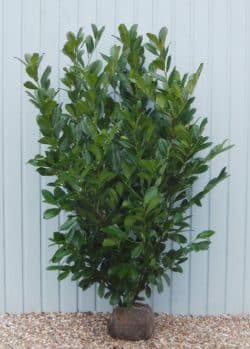
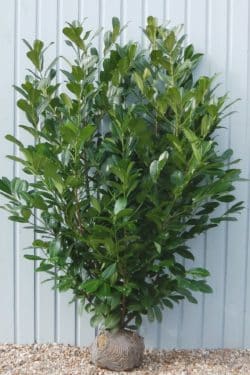
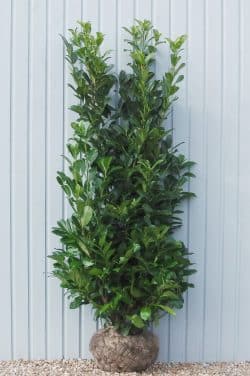
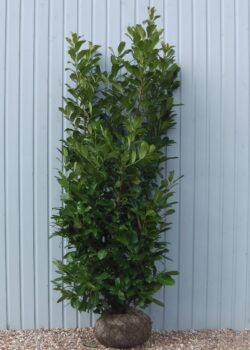
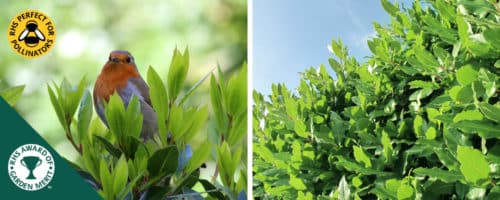
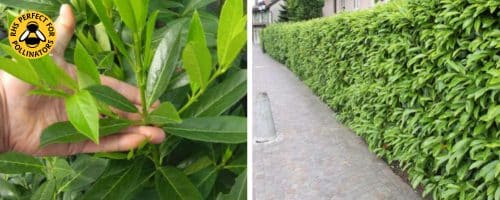
What are the benefits of growing Cherry Laurel plants?
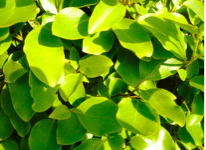
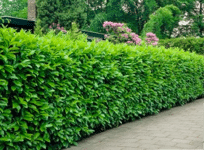
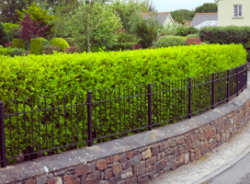
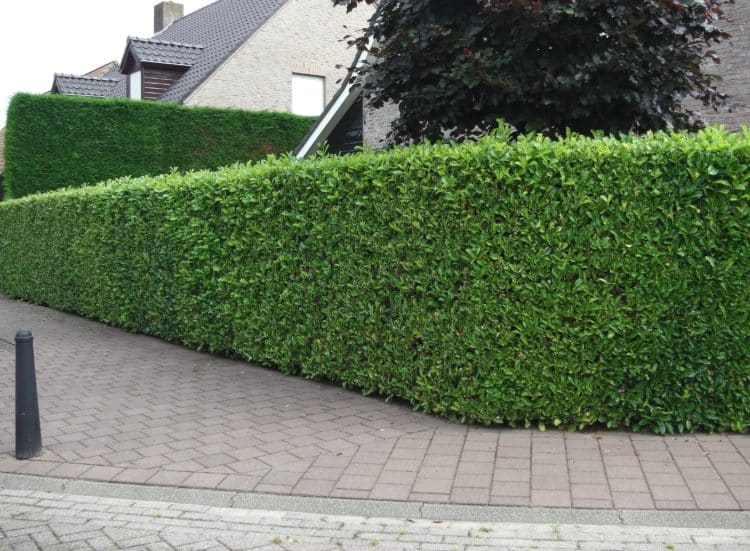
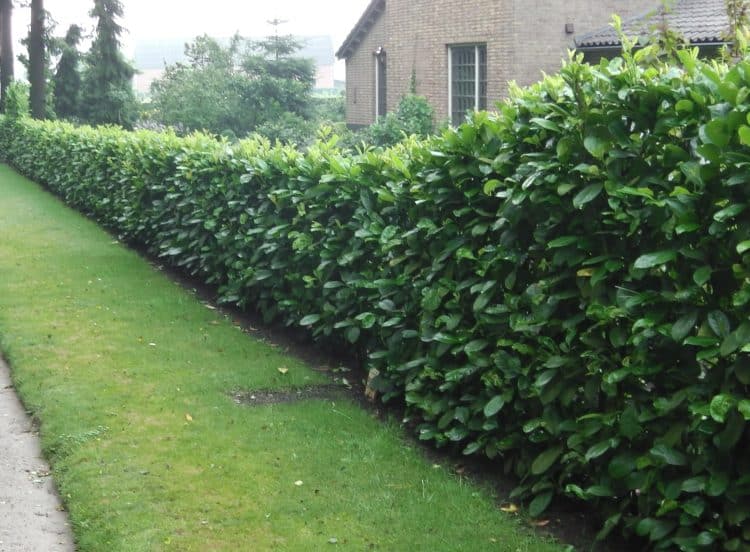
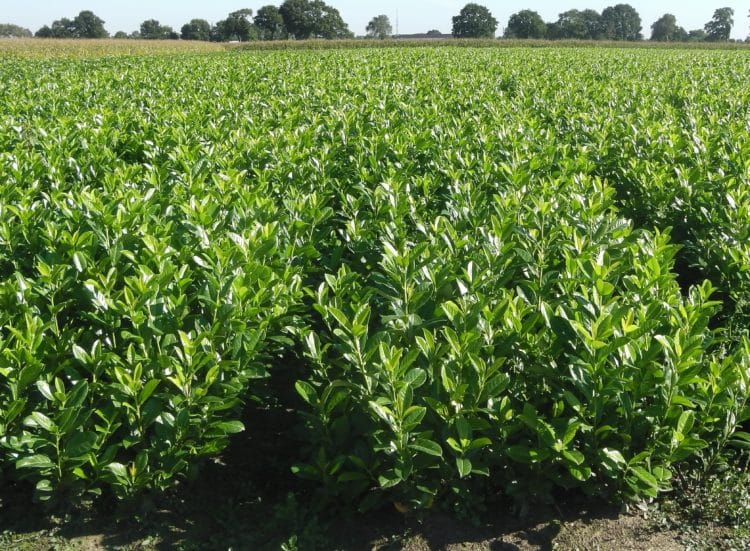
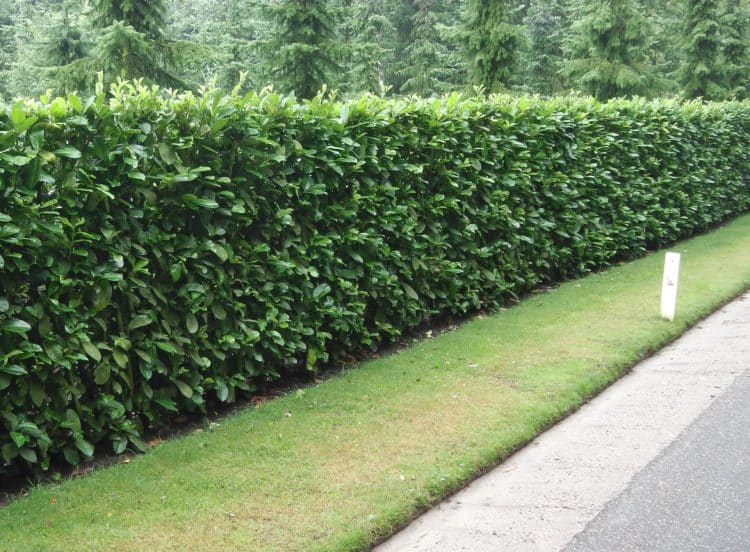
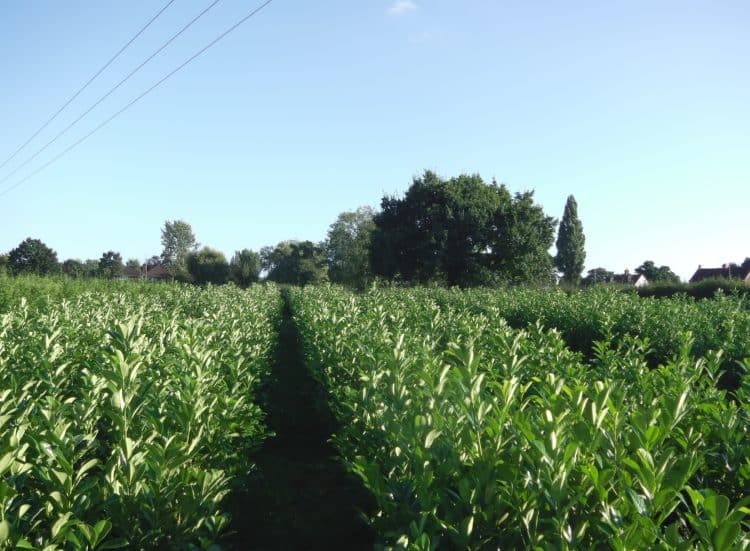
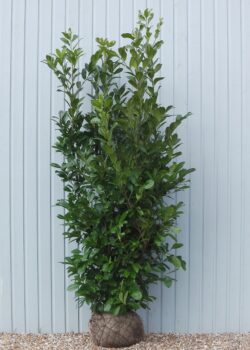
Every Laurel hedge variety has different properties, including growth speed. Cherry Laurel grows about 30-60cm a year. It’s a great choice of hedging plant if you need height, providing shade and full coverage. You can plant Cherry Laurels in many conditions. They’re happy in full sun or partial shade, and as long as the soil isn’t too chalky or too wet, the soil conditions shouldn’t affect growth too much.
What are some alternatives to Common Laurel hedge plants?
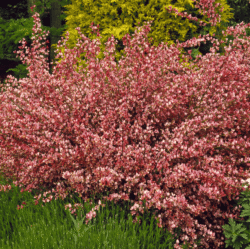
We grow and stock a complete range of Laurel plants in our nursery, including the Portuguese Laurel, Caucasica Laurel, Compact Laurel and the colourful Spotted Laurel.
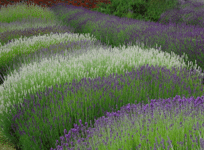
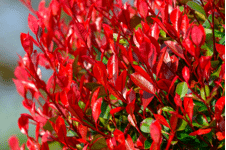
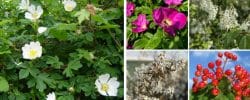
If you are looking for something a little different then many other popular and reliable species will make good alternatives including:
Learn more about evergreen hedging species for other alternatives.
When is the best time to trim Cherry Laurel hedge plants?
The best time to trim a Common Laurel hedge plant is during the growing season (avoiding the coldest months of the year so the cut edges don’t get frosted).
We recommend trimming in either early spring (before the Common Laurel hedge grows) or in autumn when growth has finished before the onset of winter, giving cut edges a chance to heal before the frost.
You can trim your Common Laurel hedge plants with shears, secateurs or a hedge trimmer. Many books will tell you to use secateurs because Cherry Laurels have large leaves, and the cut edges left by a hedge trimmer will leave them looking unkempt. It isn’t necessary, as any leaves damaged by hedge trimmers tend to be purely aesthetic, with some browning around the edges. If you trim in the spring, the new growth covers the cut edges quickly.
By trimming back your Cherry Laurel hedging ‘tight’ each year, you’ll avoid it becoming wider and wider as time goes by, taking up more valuable garden space than is necessary and eventually needing drastic remedial action. Well-treated Common Laurel hedging will show good annual growth, and the foliage will be a lustrous, rich green.
Read our detailed Laurel Trimming Guide.
How can you regenerate Old Common Laurel Hedging?
In most cases, there is no need to rip the old hedge out. Cherry Laurels can have the most drastic surgery (right back to bare stumps), and they will regenerate with young green shoots soon after. Especially if the operation happens in early spring, following a convalescent feed and mulch.
Even the most unpromising woody Common Laurel specimens can return to a lustrous display of shiny green foliage within two or three seasons.
Start by reducing the height of the Common Laurel hedge plants, then tackle the sides the following year, spreading this over a couple of seasons if you prefer. Doing this gradually, allows you to be thorough about removing any dead or diseased wood and ensuring you remove some internal branches to allow good air circulation and keep it drier in damp conditions. You should then start to see the promising new shoots soon after, certainly within two or three months.
Rejuvenating old Cherry Laurel hedges can be a rewarding pastime in one great purge, or ideally spread over several seasons. Either way, you should find these tough evergreen hedging plants remarkably resilient, giving excellent results when cut back hard.
Read our full guide to regenerating an old laurel hedge.
How do you feed a Cherry Laurel hedge?
Our general rule of thumb is to give Cherry Laurel hedges a balanced feed each spring before growth starts, ideally with a generous mulch (applied before dry weather) to retain moisture at the roots during the growing season. The suitable feeding process may also depend on the Common Laurel’s growth stage.
Read our full guide to the best fertilisers for laurel hedging.
In order not to cause too much stress to your established laurel hedge, try breaking it down into smaller stages. Start by reducing the height of the Common Laurel hedge plants, then start tackling the sides the following year, spreading the work over a couple of seasons if you prefer. Doing this piece should allow you to be thorough about removing any dead or diseased wood and ensuring some internal branches are removed to allow good air circulation and keep it drier in damp conditions.
Try and do this in early Spring if possible and remember to give the hedge a good feed and mulch after. You should then start to see the promising new shoots soon after, certainly within two or three months. Rejuvenating old Cherry Laurel hedges can be a very rewarding pastime that may be addressed in one great purge, or ideally spread over several seasons. Either way, you should find these tough evergreen hedging plants remarkably resilient and will give excellent results when cut back hard.
Steps to make before planting Common Laurel Hedging Plants
When you first plant Common Laurel hedge plants, we always recommend using bone meal, a natural organic fertiliser to be mixed well with the soil. One kilo of bone meal should be enough for approximately 15 metres of Common Laurel hedging plants.
We also suggest using Rootgrow at the time of planting. These naturally occurring native fungi form a symbiotic relationship with your new Laurel plants almost immediately, allowing them to develop the secondary root system necessary for successful growth and establishment without delay.
When planting and caring for your Cherry Laurel, ensure the soil is well-drained, as wet conditions can cause many fungal diseases to spread, and your hedge may struggle to thrive. Avoid planting your Common Laurel hedges on windy, exposed sites, as they would find these challenging conditions.
Read our full planting guide.

Rootgrow is an excellent aid to establishing a Laurel hedge
How do you maintain our Cherry Laurel Hedge?
We recommend an annual feed early in the spring with a balanced fertiliser, such as our after-plant feed. This benefits a Cherry Laurel hedge or any other evergreen if applied with mulch (a layer of moisture-retaining material, like well-seasoned bark chippings, lawn mowings or garden compost).
How do I know when the Common Laurel Hedging is mature?
Older Common Laurel hedge plants can sometimes run out of steam, making very little annual growth and looking pale and chlorotic. Assuming there is no obvious cause for this, such as a new concrete driveway. We recommend a balanced specialist fertiliser to encourage the root and top growth with magnesium to improve the leaf colour.
Our Seaweed Bio-stimulant is ideal if the root run is very dry. We recommend gently loosening the top few centimetres with a garden fork and watering well after application. This action should freshen up your Cherry Laurel hedge within a few weeks, especially, if undertaken in spring or early summer.
Common Diseases for Cherry Laurel Hedges
Cherry Laurels are popular among gardeners because they’re relatively trouble-free, a robust hedging species resistant to pests and diseases, especially once fully established.
There are common diseases to be wary of for your Cherry Laurel. Luckily, Laurels can naturally recover from these plant diseases without harsh intervention.
Leaf drop
Freshly planted Common Laurel hedge plants can ‘moult’ some of their many leaves after planting. This is more common if the weather is very harsh during winter or turns very warm in the spring when a new hedge is planted late.
Leaf loss is a stress response to conserve water. If the new plants are kept well-watered and planted in suitable soil, they should re-leaf soon after the start of the growing season once the roots have become established. ‘Leaf drop’ can be minimised by good soil preparation, sufficient watering after planting, mulching, and the application of Rootgrow will also help the new root system to establish much more quickly.
Frost damage
Common Laurel hedge plants can suffer from frost damage in autumn, winter and spring.
Autumn frost damage only occurs if the plants grow very late in the season and the soft growth does not have time to ‘harden up’ and lignify before the first hard frost killing several inches of the soft tips, turning them brown and necrotic. We advise that the dead growth is cut back to healthy, undamaged wood to prevent infection from gaining entry to the plants through the dead tissue at a time of year when the weather is cold and damp.
Winter frost damage is often associated with cold winds leading to the browning of the leaves on exposed parts of the plant; this may be at the edges or over the surface of the foliage. These damaged leaves will moult in the Spring, and fresh new foliage will appear.
Spring frost damage is more common, as this occurs with many garden plants when a late frost comes after the plants have started to grow in the spring. The new growths will often become blackened and shrivel very quickly. Again, this is not serious, as the Common Laurel hedging plants will make new secondary growths within a few weeks as the weather becomes warmer and the days get longer.
Powdery Mildew
This is a fungal disease that may be caused by one of two types (Podosphaera Tridactyla and Podosphaera Pannosa), appearing as a white powdery coating on the leaf surface of the younger growth at first. As the fungus develops, the underlying leaf tissue will turn brown and die, and the young leaves will have irregular holes, brown patches and ‘tatty’ edges to them. The symptoms of this fungus make the plants look more like insects have eaten the new leaves than suffering from disease.
Powdery Mildew usually develops due to weather conditions that encourage it, making the plants look rather unsightly, but the plants will grow out of it. Trim the plants to remove the damaged leaves, or you could give the plants a spray with a suitable Mildew Fungicide for use on ornamental plants, but neither is necessary.
Powdery Mildew is often a disease seen on younger Cherry Laurel plants that are growing strongly or very old and overgrown plants that have been cut back very hard and are making new growth. The disease will reduce as time passes and the growth pattern settles down.
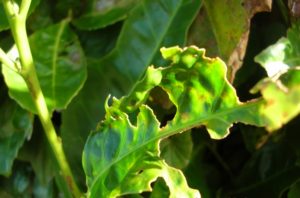
Leaf damage to Cherry Laurel caused by Powdery mildew
Leaf Spot and Shot Hole Diseases
Fungal shot hole of Laurels
Infections of leaf spot fungi (Stigmina Carpophila and Eupropolella Britannica) result in brown spots on the leaves. Over time, Laurel hedge plants will control the infection causing both the healthy and diseased parts of the leaf to separate, resulting in the centres of these spots falling out. This leaves behind various irregular holes in the foliage, known as ‘shot holes’. The fungal spores are spread and dispersed by rain.
Bacterial shot hole disease of Laurels
Bacterial shot hole disease is caused by the bacterium, Pseudomonas Syringae and is spread by wind and rain, causing the bacteria to enter the leaves through either damaged tissues or the natural leaf openings (stomata). You can identify the disease by light brown lesions that gradually become larger, unlike the fungal shot hole disease, the lesions have a yellow halo around the edge. Again, as the plant controls the infection, the infected and healthy parts of the leaf separate, and the centre drops out to leave irregular holes.
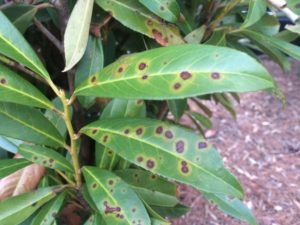
Bacterial Shot hole disease of Cherry Laurel caused by Pseudomonas
Wet conditions will encourage the development and spread of both these shot-hole diseases. When drier conditions return, the infection will likely clear up without further intervention.
Read more about Laurel pests and diseases.
Contact Hope Grove Nurseries
If you have any queries about Cherry Laurel hedges or Cherry Laurel hedging, call us on 01580 765 600 and our friendly, expert team can assist you.